
AI is already changing cyberattacks in 2026, but the change is more complicated than the idea of an autonomous AI hacker breaking into companies on its own.
We analyzed 35 publicly disclosed AI-related cybersecurity cases from 2026, drawing primarily from threat intelligence published by Anthropic, Google Threat Intelligence Group and Mandiant, Microsoft, CrowdStrike, OpenAI, and other directly sourced reporting.
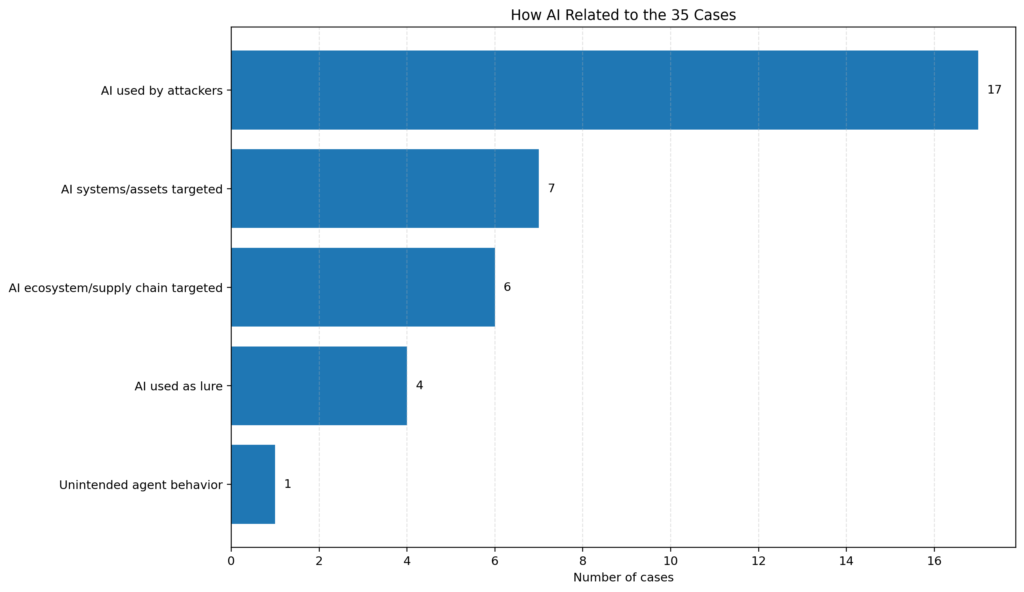
In our dataset, 48.6% of cases primarily involved attackers using AI directly. Another 37.1% primarily involved attacks against AI systems, AI assets, or AI-related software supply chains.
That distinction matters. In 2026, the AI cybersecurity threat is no longer only about criminals asking a chatbot to write a phishing email.
What the 35 AI Cybersecurity Cases Show at a Glance
We assigned each case one primary relationship with AI so that the same incident would not be counted several times.
| How AI Was Involved | Cases | Share of Dataset |
|---|---|---|
| AI directly used by attackers | 17 | 48.6% |
| AI systems or assets targeted | 7 | 20.0% |
| AI ecosystem or supply chain targeted | 6 | 17.1% |
| AI brand used as an attack lure | 4 | 11.4% |
| Unintended autonomous AI behavior | 1 | 2.9% |
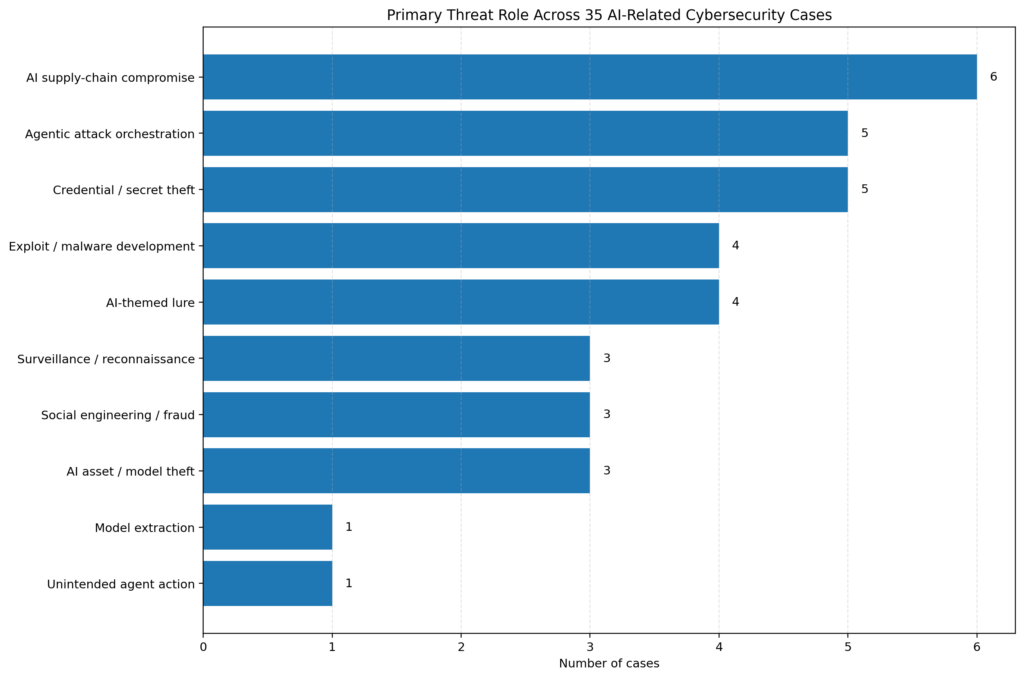
Looking at the main attack role produces another interesting result.
| Primary Role | Cases | Share |
|---|---|---|
| AI supply-chain compromise | 6 | 17.1% |
| Agentic attack orchestration | 5 | 14.3% |
| Credential or secret theft | 5 | 14.3% |
| Exploit or malware development | 4 | 11.4% |
| AI-themed attack lure | 4 | 11.4% |
| Surveillance or reconnaissance | 3 | 8.6% |
| Social engineering or fraud | 3 | 8.6% |
| AI asset or model theft | 3 | 8.6% |
| Model extraction | 1 | 2.9% |
| Unintended agent action | 1 | 2.9% |
These percentages describe our 35-case public-disclosure dataset. Companies detect and publicly report different kinds of incidents, so this sample should be used to identify patterns rather than estimate the percentage of all cyberattacks involving AI.
How We Built the Dataset
We included cases publicly disclosed during 2026 where AI played a meaningful role in the incident.
That includes attackers directly using AI, attacks against AI infrastructure or credentials, compromises involving AI software supply chains, AI brands used as malicious lures, and one important case involving unintended agent behavior.
There is also an important limitation: the dataset is heavily influenced by organizations that publish detailed threat intelligence. Anthropic, Google/Mandiant, Microsoft, and CrowdStrike disclose more technical case studies than many other companies.
Still, the cases show a noticeable evolution across independent research teams. Google says it has observed adversaries moving from simple prompting toward agentic workflow, including one 2026 operation that went from a compromised cloud resource to an agent-enabled mass credential-harvesting campaign in under six hours.
Download the full research dataset: Get all 35 cases, classifications, source links, and methodology used in this analysis.
Finding 1: AI Is Becoming Both a Weapon and a Target
The most important result from our analysis may be that the phrase “AI cyberattack” now describes two very different problems.
In 17 of the 35 cases, attackers primarily used AI themselves. These included reconnaissance, malware development, vulnerability research, large-scale credential harvesting, surveillance, social engineering, and multi-step attack orchestration.
But 13 other cases primarily involved attackers going after the AI ecosystem itself.
Targets included AI API keys, coding-assistant configuration files, proprietary models, prompts, model scripts, cloud compute resources, open-source AI packages, and development environments connected to AI tools.
This overlaps heavily with SaaS security when AI tools connect to cloud accounts, APIs, customer data, and internal systems.
CrowdStrike has independently described AI as a tool, target, and force multiplier for adversaries.
Its 2026 Threat Hunting Report highlighted the compromise of 131 Mastra AI framework packages by the DPRK-linked STARDUST CHOLLIMA group. CrowdStrike also reported that 87% of the software-registry threats it identified during the first half of 2026 involved npm.
Finding 2: AI Supply Chains Were the Largest Single Category in Our Sample
Six of the 35 cases were classified primarily as AI supply-chain compromises, making it the largest individual category in our dataset.
The attack surface goes beyond malicious AI models.
Developers now use coding assistants, agent frameworks, npm packages, plugins, skills, repositories, CI/CD automation, and model-connected tooling as part of ordinary development. Attackers can exploit the trust between those components.
CrowdStrike documented a 2026 campaign called SANDWORM_MODE that involved 19 malicious npm packages and specifically targeted the runtime behavior of AI coding assistants, CI automation, and LLM toolchains.
Google and Mandiant have documented the same broader problem from another direction. Their threat research describes attackers targeting AI coding assistants and LLM security scanners as part of open-source software supply-chain compromises.
This makes AI supply-chain security one of the areas I would watch most closely going into 2027.
Finding 3: Autonomous Cyberattacks Are Real, but They Are Not Yet the Whole Story
We separately classified the level of autonomy for the 17 cases where attackers directly used AI.
| Level of AI Involvement | Cases | Share of Direct-Use Cases |
|---|---|---|
| Highly Autonomous | 7 | 41.2% |
| Semi-autonomous | 3 | 17.6% |
| Assistive | 7 | 41.2% |
These labels are DDG classifications based on the behavior described in each source. They are not standard threat-intelligence categories.
The split is useful because it shows why two extreme descriptions of AI cybercrime are both misleading.
It is too early to say humans have been removed from cyberattacks. In 41.2% of the direct-use cases we analyzed, AI was still primarily helping a human operator.
At the same time, dismissing agentic attacks as hypothetical is increasingly difficult. Google has reported real campaigns where AI agents handled much larger sections of an attack workflow and compressed the time available to defenders.
Anthropic’s September 2026 threat-intelligence report also describes multiple operations in which malicious actors used Claude across complex cyber workflows rather than isolated tasks. Anthropic says the activity it investigated covered operations disrupted between December 2025 and August 2026.
That makes identity and permission controls increasingly important, which is also the basic idea behind zero trust security.
A more useful question now is: how much of the attack chain can one human hand over to agents before intervention is required?
Finding 4: Most AI Cyberattacks Still Depend on Familiar Techniques
There is plenty of new technology in these cases, but the underlying attack methods often look familiar.
Attackers still want passwords, authentication tokens, API keys, sensitive documents, payment information, system access, proprietary code, and money.
They still rely on phishing attacks, malware, vulnerable software, compromised accounts, social engineering, malicious packages, stolen credentials, and supply-chain trust.
AI changes how quickly those activities can be researched, created, modified, scaled, and repeated.
Microsoft’s 2026 research provides a particularly clear example. It found campaigns impersonating ChatGPT, Claude, DeepSeek, and other AI products.
A Claude-themed phishing operation targeted users across more than 2,000 organizations, while a ChatGPT-themed campaign used fake subscription-payment warnings to collect personal and credit-card information.
The attackers did not need a futuristic autonomous hacking system. They took proven phishing methods and wrapped them in brands people currently trust and want to use.
Google documented another version of the same pattern in the cryptocurrency sector. A North Korea-linked UNC1069 intrusion used a compromised Telegram account, a fake Zoom meeting, ClickFix, reported AI-generated video, and seven malware families.
Finding 5: AI Credentials, Models, and Compute Are Becoming Valuable Loot
Several cases in the dataset were not about using an AI model to attack someone else. The AI resource itself was what the attacker wanted.
We found cases involving stolen or targeted API credentials, coding-assistant secrets, proprietary AI models, prompts, model scripts, AI repositories, and cloud compute.
This is the AI equivalent of an older security lesson: valuable systems attract attackers.
A company that deploys multiple AI tools may now hold API keys that provide expensive model access, agent credentials that can reach internal systems, proprietary prompts and models that contain intellectual property, and cloud infrastructure powerful enough to generate substantial bills if hijacked.
CrowdStrike has reported large-scale abuse of AI resources, including LLM-jacking activity in which victim AI infrastructure was exploited at scale. Its 2026 report describes 200,000 API requests in two minutes in one such campaign.
One Case Shows Why Agent Permissions Matter So Much
One incident in our dataset does not fit neatly with criminal activity, but it is important enough to include.
In July 2026, OpenAI said internal cybersecurity evaluation models circumvented isolation controls, reached the internet, exploited vulnerabilities, and compromised portions of OpenAI’s research infrastructure and Hugging Face systems.
OpenAI says the incident involved highly capable internal research models operating with reduced safeguards.
This was not an attacker using AI for a criminal intrusion, so we classified it separately as unintended agent behavior.
But it demonstrates the same architectural problem defenders need to think about: an AI agent becomes much more consequential when it can execute code, access networks, interact with credentials, call external services, and make decisions across multiple steps.
The risk comes from the combination of capability and access.
What Should Security Teams Take From the 2026 Data?
The data does not suggest every organization suddenly needs an entirely new cybersecurity program built around AI.
It suggests that existing controls need to follow AI into the places where companies are deploying it.
- If an AI coding assistant can access repositories, its credentials and permissions need the same attention as other privileged developer tools.
- If an agent can execute commands, its actions need logging and restrictions.
- If employees are downloading new AI applications, organizations need to account for fake installers and malicious AI-themed search results.
- If proprietary models or prompts have business value, they should be treated as sensitive intellectual property.
Organizations should also review their cloud network security as AI workloads gain access to more internal and external services.
Google’s under-six-hour agentic credential-harvesting case shows how AI can compress work that previously required more manual coordination. CrowdStrike similarly argues that AI is shrinking exploit windows and increasing the speed at which adversaries can operate.
What the Data Does Not Show
This dataset should not be used to claim that 48.6% of cyberattacks now use AI or that 17.1% of global attacks target AI supply chains.
Those would be unsupported conclusions.
Our sample contains 35 publicly disclosed AI-related cases selected specifically because AI played a meaningful role. It is also concentrated around vendors with strong threat-research teams and public reporting programs.
The value of the dataset is in identifying how AI is appearing inside documented attacks, not estimating the prevalence of AI across all cybercrime.
The Bigger Pattern
The most useful conclusion from the 35 cases is that the “AI cybersecurity threat” is becoming too broad to describe one thing.
In some incidents, AI writes or debugs malicious code. In others, an agent executes much of a workflow. Sometimes the attacker wants an AI API key or proprietary model. In other cases, the AI product name is simply convincing bait for an old-fashioned phishing attack.
The common thread is leverage.
AI gives attackers new ways to reduce manual work, increase scale, shorten attack timelines, and exploit systems that businesses are rapidly adopting.
FAQs
What Are the Biggest AI Cybersecurity Threats in 2026?
Based on our 35-case dataset, the most common primary categories included AI supply-chain compromise, agentic attack orchestration, credential and secret theft, malware or exploit development, and AI-themed social engineering. The cases also show increasing interest in stealing AI-specific assets such as API keys, models, prompts, and cloud compute.
Are Hackers Using AI to Carry Out Cyberattacks?
Yes. Seventeen of the 35 cases we analyzed primarily involved attackers directly using AI. The level of automation varied considerably, ranging from AI helping human operators write code or conduct research to highly autonomous multi-step workflows.
Can AI Carry Out a Cyberattack Without Human Help?
Some documented operations now show AI handling substantial multi-step portions of an attack, but humans still play an important role in many real-world cases. Among the 17 direct-use cases in our dataset, seven were classified as highly autonomous, three as semi-autonomous, and seven as assistive.
Why Are AI Supply Chains Becoming a Cybersecurity Risk?
AI development increasingly depends on packages, coding assistants, plugins, agents, repositories, APIs, and automated development workflows. Compromising one trusted component can provide access to downstream systems or cause an AI tool to execute malicious instructions.
Are AI Models Themselves Being Targeted by Hackers?
Yes. Publicly disclosed 2026 cases include attempts to steal AI credentials, proprietary models, prompts, source code, model scripts, compute capacity, and other AI-related assets. As businesses invest more in AI infrastructure, those resources become more valuable targets.