
Cybercrime is now one of the most expensive threats facing the digital world. Latest data shows global cybercrime damages are projected to reach $10.5 trillion USD annually by 2025, growing at about 15 % each year dwarfing the GDP of many countries and underscoring the urgency for strong cyber defenses.
The FBI’s records reveal the far-reaching impact, with at least 422 million individuals affected and a substantial 800,944 complaints filed in 2022 alone. Alarming estimates predict 33 billion account breaches in 2023, translating to 2,328 daily and 97 victims every hour. Thus, it’s crucial to perform cybersecurity measures and be informed about the current cyber threats in 2023.
This article will cover different types of cyber-attacks and provide examples and practical ways for individuals and organizations to protect themselves in this threat landscape. These familiar attack categories are also evolving as criminals adopt AI tools.
Our analysis of 35 documented AI cybersecurity cases examines how the technology is being used in real-world attacks. But for now, let’s discuss the seven types of cyber attacks.
Cyber attacks can steal personal information, lock important files, compromise accounts, or shut down entire networks. Here are seven common types of cyber attacks, how they work, and what you can do to stay protected.
| Cyber Attack | What It Does | How to Protect Yourself |
|---|---|---|
| 1. Ransomware | Encrypts files and demands payment to restore access. | Back up important files and keep software updated. |
| 2. Phishing | Uses fake emails, messages, or websites to steal information. | Check suspicious links and verify senders. |
| 3. DDoS Attacks | Floods websites or servers with traffic, making them unavailable. | Use DDoS protection and traffic filtering. |
| 4. Man-in-the-Middle (MITM) | Intercepts communication between two parties. | Use HTTPS and avoid untrusted networks. |
| 5. Password Attacks | Steals, guesses, or cracks passwords to access accounts. | Use unique passwords and multi-factor authentication. |
| 6. Malware | Infects devices to steal data, spy, or damage systems. | Install security updates and avoid suspicious downloads. |
| 7. Botnets | Uses networks of infected devices to launch attacks. | Secure connected devices and change default passwords. |
What is a Cyber Attack?
A cyber-attack is a malicious and deliberate attempt to compromise the security of computer systems, networks, or digital devices. These attacks can involve unauthorized access, disruption, theft, manipulation, or destruction of sensitive data, information, or infrastructure.
Cyber-attacks are carried out by individuals, groups, or even nation-states with various motives, including financial gain, political or ideological agendas, espionage, or simply causing disruption.
7 Types of Cyber Attacks
There are multiple types of cyber-attacks through which an attacker can gain access to your network system. Here, we will discuss only the top 7 cyber-attacks that you should be aware of.
1. Ransomware Attacks
In 2022, there were approximately 2.3 billion ransomware attacks, reflecting an 80% surge compared to 2021. It stands among the top three commonly encountered attacks most organization faces.
Ransomware is a type of malware that locks victims’ data using encryption, demanding payment for access. It spreads swiftly through networks, targeting files and databases, potentially crippling entire organizations.
It arises via malicious links, email attachments, vulnerabilities, or worms. After infecting, it spreads across devices and connects to the attacker’s server. Encryption occurs with asymmetric keys, needing payment for decryption via the attacker’s private key.
Costa Rica encountered a ransomware incident exemplified by a national crisis, as 30 government institutions suffered consecutive attacks within a brief timeframe.
2. Phishing Attacks
Constituting 16% of cases, phishing ranked as the second leading cause of data breaches. It also carried the highest financial impact, averaging $4.91 million in breach expenses.
Phishing attacks rely on social engineering, with criminals impersonating trusted organizations to trick people into clicking malicious links or sharing sensitive information. Learning how to prevent phishing attacks is essential because even convincing messages can contain warning signs.
Unsuspecting recipients may click malicious links or open attachments, unwittingly providing access to sensitive data and account details, enabling potential malware installation.
An example of a major phishing incident is the bogus invoice scheme, which inflicted losses exceeding $120 million on Google and Facebook during 2013-2015.
3. Distributed Denial of Service (DDoS) Attack
This type of attack strives to overpower a target’s network or servers with an immense barrage of traffic or requests. These assaults employ multiple compromised hosts under the attacker’s control, causing the system to slow down or halt, disrupting its regular functions.
Although its primary objective isn’t data theft, its intention is to exhaust an organization’s time, finances, and resources during the restoration of crucial operations to their regular state.
Notably, in February 2020, Amazon Web Services (AWS) faced the largest DDoS attack ever recorded.
4. Man-in-the-middle attack (MITM)
Over a third of inadvertent vulnerability exploits involve MITM attacks, per IBM’s X-Force Threat Intelligence Index 2018.
In a MITM attack, hackers insert themselves into a two-party transaction, intercept traffic, and steal data. These attacks often target unsecured public Wi-Fi users, with attackers inserting themselves between visitors and networks to install malicious software and manipulate data.
Such breaches frequently center on compromised identities, with CrowdStrike noting 80% of breaches using them, taking up to 250 days to detect.
For instance, the Equifax incident impacted 2.5 million customers, totaling 145.5 million, due to MITM attacks.
5. Password Attack
Over 80% of confirmed breaches stem from compromised, weak, or reused passwords. Password attacks exploit authentication weaknesses by guessing, stealing, or cracking passwords. Phishing-resistant methods such as passkeys can reduce reliance on passwords and help protect accounts from credential theft. Hackers employ tools like Cain, Abel, Air crack, and Hashcat to crack passwords.
A classic example of a phishing password attack tricks users into believing their account faces deactivation unless they confirm login data. Using a website like http://Xyz.com, attackers send fraudulent emails stating an account breach, urging credit card and login details.
Clicking the link, http://Xyz.com/confirm-details redirects victims to a fake confirmation page. Here, they input real credentials, enabling hackers to access the legitimate account.
6. Malware
Malware, an abbreviation for “malicious software,” disrupts networks and pilfers data. Effective endpoint security helps organizations monitor computers and other devices for malicious activity, reduce infection risks, and detect suspicious behavior.
Malicious programs pose as harmless but infiltrate systems, often affecting entire networks. These assaults aim to steal personal or corporate data and disrupt operations. In fact, in 2022, there were over 5.5 billion malware attacks worldwide. Common malware categories include worms, viruses, ransomware, trojans, and backdoors.
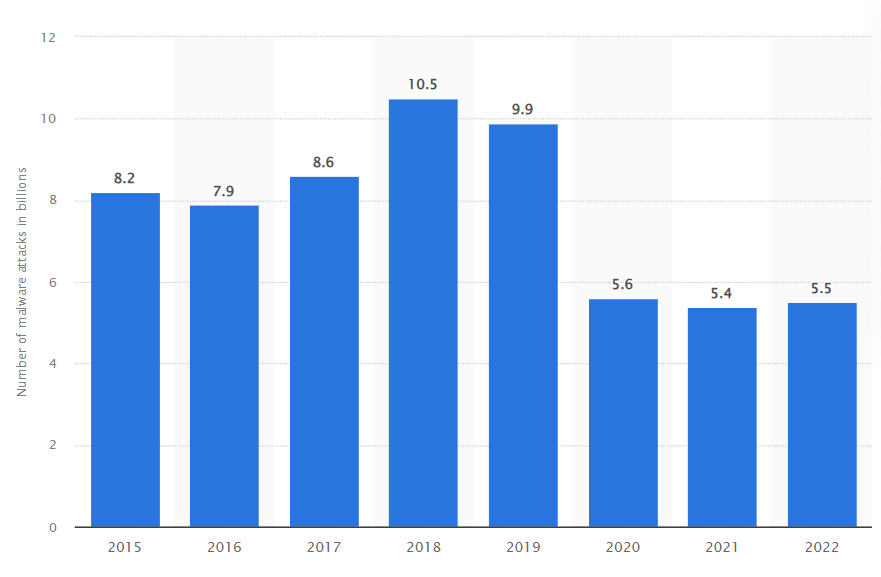
Source: Global malware attack counts annually, spanning 2015 to 2022 (in billions)
Prominent incidents encompass Crypto Locker ransomware (2013), Emote trojan (2014), Mirai botnet (2016), Petya ransomware/NotPetya wiper (2016/7), and Clop ransomware (2019-Present).
7. Botnets
In Q4 2021, Spam Haus’s Botnet Threat Update noted a 23% rise in botnet C&C (command and control) attacks, increasing from 2,656 in Q3 to 3,271 in Q4.
A botnet is a cluster of connected devices, each hosting one or more bots. Botnets execute tasks like DDoS attacks, data theft, spam distribution, and unauthorized access. Command and control software directs these networks.

Notable examples include Zeus (2009), responsible for financial losses due to banking data theft, and Cutwail (2009), a major spam botnet generating a substantial share of global spam emails at its peak.
How to Prevent These Types of Cyber Attacks
Engaging in the following practices will deter a range of cyberattacks:

- Regularly update and strengthen passwords. Avoid complexity that leads to forgetting and never reusing them.
- A structured threat and vulnerability management process helps identify weaknesses and prioritize fixes before attackers exploit them. Trust certified antivirus software.
- Use a firewall, intrusion prevention systems, access controls, and application security measures to reduce exposure to network-based attacks.
- Exercise caution with unfamiliar sender emails. Scrutinize for anomalies.
- Employ a VPN for encrypted traffic between the server and the device.
- Back up data thrice on different media types, including off-site storage (cloud).
- Train employees in cyber threat awareness.
- Embrace Two-Factor or Multi-Factor Authentication for robust account security.
- Secure Wi-Fi networks and abstain from public Wi-Fi without VPN.
- Secure your smartphone by installing apps from trusted sources, keeping the operating system updated, and reviewing app permissions regularly.
Wrap Up
As cyber threats persist, protecting against them is vital in the digital era. Understanding phishing, malware, and ransomware is key. Employing cyber security best practices helps organizations and individuals mitigate risks, ensuring defense against data breaches and device compromise.
Visit Daily Digital Grind to stay informed and vigilant against cyber risks.
FAQs
How can cyber-attacks be dealt with?
Combatting cyber-attacks necessitates strict adherence to best cyber security practices. Prevention, detection, and rapid response through robust measures, advanced tools, and expert collaboration are essential to effectively safeguard against evolving threats.
What are the most common types of cyber-attacks?
Prominent are ransomware, phishing, DDoS, MITM, malware, password, and botnet attacks. These prevailing threats demand proactive cyber security measures for effective defense.
What is the impact of cyber-attacks on your business?
The consequences of cyber-attacks on your business are substantial. They can tarnish your reputation, erode customer trust, and result in loss of customers and sales, jeopardizing overall business stability.