
The AI boom has created some of the world’s most valuable private companies. But there’s still one question Wall Street hasn’t had to answer: What happens when investors finally get to decide what one of these companies is worth?
Anthropic, the company behind Claude AI, could soon provide that answer.
Its highly anticipated IPO is drawing attention because of enormous expectations around AI, billions spent on computing infrastructure, and growing questions about whether the industry can turn rapid growth into sustainable profits.
CNBC’s Jim Cramer has suggested that Anthropic’s stock market debut could make or break the broader AI trade.
That sounds dramatic.
So what could happen if Anthropic’s IPO doesn’t live up to the hype? And how much of the AI market could feel the impact?
Anthropic’s planned IPO could become a major test of investor confidence in artificial intelligence. The company behind Claude AI has attracted enormous investment, but its growing computing costs and financial losses raise questions about long-term profitability.
A successful stock market debut could boost confidence in AI companies and their suppliers, while a disappointing valuation or weak investor demand could put pressure on the broader AI sector.
Why Does Anthropic’s IPO Matter for the AI Market?
Anthropic’s IPO could become one of the biggest tests of Wall Street’s confidence in AI. Investors have poured billions into AI chips, data centers, and cloud infrastructure, expecting companies like Anthropic to generate enough revenue to make those investments worthwhile.
Now, Anthropic is preparing to put those expectations to the test.
The company filed its IPO paperwork on October 26, 2026. Its planned stock market debut comes at a difficult time for AI stocks, as investors grow increasingly concerned about rising infrastructure costs and how long it will take for AI companies to become profitable.
Why Jim Cramer Thinks Anthropic’s IPO Could Make or Break AI Stocks?
CNBC’s Jim Cramer believes Anthropic’s IPO could influence the direction of the broader AI market.
During his November 9 episode of Mad Money, Cramer argued that a successful offering could help struggling AI stocks recover. But if investors show little interest in Anthropic’s shares, it could deepen concerns about the industry’s already high valuations.
And there’s a reasonable argument behind his concern.
Companies like Nvidia are making enormous amounts of money selling AI processors. Cloud providers are investing heavily in data centers. Meanwhile, AI developers such as Anthropic face the difficult task of turning all that expensive computing power into profitable products.
A disappointing IPO could make investors more skeptical of the enormous spending plans supporting the AI industry.
Why the IPO Could Affect Nvidia, Amazon, and Google?
Anthropic has close financial and commercial relationships with several major technology companies.
Amazon and Google have invested in Anthropic and provide access to computing infrastructure. Nvidia supplies the powerful processors that support much of the broader AI industry.
These relationships mean that Anthropic’s performance could influence how investors view other companies involved in the AI boom.
Consider the scale of infrastructure spending already underway.
Microsoft’s $9.7 billion AI data-center deal with Iren is one example of the massive financial commitments being made to support growing demand for AI computing.
What Do Anthropic’s IPO Financials Reveal?
Here’s a quick overview of where Anthropic currently stands in terms of financials:
| Financial Metric | Q3 2026 |
|---|---|
| Revenue | $16.96 billion |
| Quarter-over-quarter revenue growth | 47% |
| Net loss | $23.29 billion |
| Operating loss | $567 million |
| Future compute commitments | $895.4 billion, as reported November 2 |
Anthropic is bringing in billions of dollars from its AI products, but the cost of running and expanding those services is enormous.
Its latest IPO disclosures show a company growing at an extraordinary pace while spending heavily on computing infrastructure. That combination is attracting attention from investors because Anthropic needs to prove it can eventually turn its growing revenue into profits.
How Much Revenue Is Anthropic Generating?
Anthropic reported $16.96 billion in revenue for the third quarter of 2026, up 47% from the previous quarter, according to its updated IPO filing. That’s impressive growth for a company founded in 2021.
But there’s an interesting detail behind those numbers.
In the second quarter, Anthropic’s revenue had grown 144% from the previous quarter. By the third quarter, that growth rate had fallen to 47%. The company is still expanding rapidly. Its pace of growth is becoming harder to maintain as the business gets larger.
Anthropic earns revenue through Claude subscriptions, API access for developers, and enterprise services. Businesses can integrate Claude into their software, automate workflows, and use its models for tasks such as coding, research, and document analysis.
Why Is Anthropic Losing So Much Money?
Anthropic reported a $23.29 billion net loss in the third quarter of 2026, even as revenue increased. That figure looks alarming, but it needs some explanation.
A company’s net loss can include accounting adjustments and other expenses that don’t directly represent money leaving its bank account during the quarter.
For a clearer picture of its ongoing business, investors also examine operating results. Anthropic recorded an operating loss of approximately $567 million during the quarter.
That shows how expensive it remains to develop and deliver advanced AI services.
Training powerful models requires enormous computing resources. Once a model is released, Anthropic must continue paying for the infrastructure used to handle customer requests.
And unlike traditional software, every additional AI request can create meaningful processing costs.
For example, a company selling ordinary software may serve thousands of extra customers without dramatically increasing its infrastructure spending. An AI provider handling millions of complex requests needs enough computing capacity to process them.
The Bigger Concern: Nearly $900 Billion in Computing Commitments
Anthropic’s infrastructure commitments may be even more significant than its quarterly losses. Its IPO disclosures identify approximately $895.4 billion in future spending commitments, much of it connected to computing infrastructure.
These commitments reflect the enormous resources needed to support Anthropic’s plans for more powerful AI models and wider commercial adoption.
They also create financial pressure.
Anthropic relies on infrastructure partners, including Amazon and Google, to provide computing capacity. Building that capacity requires expensive processors, data centers, networking equipment, and reliable electricity.
Computing costs are becoming a major concern across the industry. OpenAI has also explored developing its own chips with Broadcom and TSMC to reduce its dependence on outside suppliers.
If financing becomes more expensive or difficult to obtain, Anthropic could face delays, higher costs, or changes to its planned computing capacity.
How Much Could Anthropic Be Worth After Its IPO?
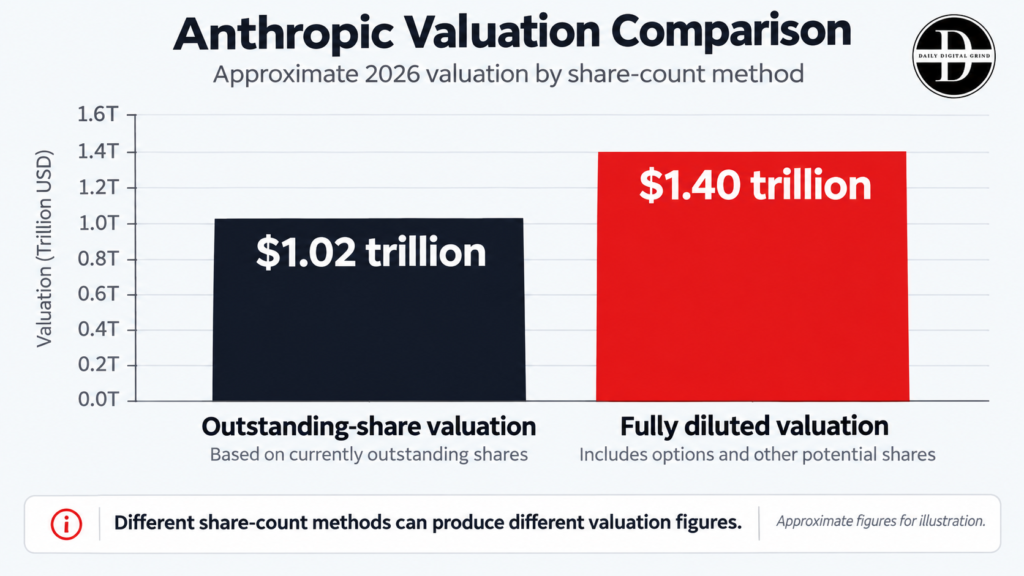
Anthropic could reach a valuation of up to $1.4 trillion when it goes public, making its stock market debut one of the most closely watched events in the technology industry.
According to its November 10, 2026, IPO filing, the company plans to offer 825 million shares at an estimated price of $70 to $78 each. At the upper end of that range, the offering could raise approximately $64.4 billion.
The proposed valuation is a remarkable figure for a company founded in 2021. It also puts Anthropic under pressure to deliver the kind of financial growth investors normally expect from the world’s largest technology businesses.
Why Is Anthropic’s Valuation So High?
Anthropic’s valuation is high because the company has developed Claude into a commercial product used by businesses, developers, and individuals. Its revenue has grown rapidly as organizations adopt AI for coding, research, customer support, and other business tasks.
However, investors are being asked to pay for profits Anthropic hasn’t consistently demonstrated yet.
Much of the company’s value depends on its ability to keep attracting customers, improve the efficiency of its AI models, and eventually generate enough earnings to support its enormous infrastructure costs.
Consider its most recent private funding round. In May 2026, Anthropic reached a valuation of approximately $965 billion.
Its proposed IPO valuation of up to $1.4 trillion represents a substantial increase in just a few months.
That increase suggests investors still see enormous potential in Anthropic’s business. But public markets can be less forgiving than private funding rounds, especially when companies carry significant financial risks.
Investor excitement around Anthropic was already visible earlier in 2026. Technology commentator Aakash Gupta highlighted how quickly private-market expectations were changing.
What Does the $70–$78 IPO Price Mean for Investors?
Anthropic’s proposed share-price range gives investors their first clear indication of how the company expects to be valued on the public market.
At $70 to $78 per share, the offering would raise approximately $57.8 billion to $64.4 billion before expenses.
However, the amount raised and the company’s total valuation are two different things.
The offering involves only part of Anthropic’s overall share capital. Its total valuation depends on the number of shares outstanding, including the treatment of options and other equity awards.
For example, Reuters estimates a valuation of approximately $1.02 trillion using outstanding shares, while the fully diluted valuation could reach roughly $1.4 trillion.
The proposed $70–$78 range is also preliminary. Strong demand during the IPO roadshow could influence the final pricing, while weaker interest could put pressure on the offering.
What Happens If Anthropic’s IPO Succeeds or Disappoints?
Anthropic’s IPO could influence investor confidence across the AI industry, especially after months of concerns about expensive data centers, rising computing costs, and high technology valuations.
A strong opening could encourage investors to keep backing AI companies. Alternatively, a disappointing debut could make them reconsider how much they’re willing to pay for future growth.
But the outcome won’t depend entirely on Anthropic’s first trading day. Its performance over the following months will reveal much more about investor confidence.
The Bull Case: A Successful IPO
A strong Anthropic IPO could boost confidence in AI stocks. High demand for its shares would suggest investors still see growth potential in the industry.
It could also encourage investment in other AI companies and support positive sentiment around technology stocks.
However, Anthropic would still need to prove it can turn its growing revenue into consistent profits.
The Bear Case: A Disappointing IPO
A weak IPO could make investors more cautious about expensive AI stocks.
If Anthropic struggles to attract buyers or its share price falls, investors may question the high valuations of other AI companies.
This could make fundraising harder for AI startups and put pressure on businesses spending heavily on AI infrastructure.
Bull vs. Bear: Anthropic IPO
The table below shows how a successful or disappointing Anthropic IPO could affect investor confidence, AI companies, and the broader technology market.
| Factor | Bull Case | Bear Case |
|---|---|---|
| Investor confidence | Improves | Weakens |
| Anthropic shares | Strong demand | Weak demand |
| AI startups | Easier fundraising | Tougher fundraising |
| AI infrastructure | Spending confidence grows | Spending faces more scrutiny |
| AI stocks | Potential gains | Possible declines |
What Should Businesses Watch After Anthropic Goes Public?
Anthropic’s IPO could bring changes for businesses that rely on Claude for everyday work. As a publicly traded company, Anthropic would face greater pressure to grow revenue, control expenses, and meet investor expectations.
For businesses, the main things to watch are Claude’s pricing, service reliability, and future development.
Could the IPO Affect Claude’s Pricing?
Anthropic hasn’t confirmed any pricing changes tied to its IPO. However, pressure to improve profitability could influence how it charges for Claude in the future.
Businesses using Claude’s API may see changes in usage limits, subscription plans, or pricing for advanced models.
Price increases aren’t guaranteed. Anthropic also faces competition from OpenAI and Google, which gives it a reason to keep its services affordable.
Businesses should monitor Claude’s pricing updates and review their AI spending regularly, especially if they depend on its API for customer-facing applications.
What It Means for Enterprise AI Adoption
Going public could give Anthropic more funding to develop Claude, improve its infrastructure, and expand enterprise services. That could benefit companies using AI for coding, customer support, research, and document processing.
However, businesses should avoid depending entirely on one AI provider. Changes in pricing, model availability, or service performance could affect daily operations.
Account management matters too. For example, Claude’s restrictions on changing account email addresses have raised concerns about account portability and long-term access.
Companies making long-term investments in Claude should also evaluate alternatives, test model performance, and check contract terms before expanding their usage.
Bottom Line
Anthropic’s IPO could become an important moment for the AI industry. Strong investor demand may boost confidence in AI companies, while a disappointing debut could raise concerns about high valuations and future profits.
For investors, the company’s financial results after listing will offer a clearer picture than its opening share price. Businesses using Claude should focus on pricing, reliability, and long-term service improvements.
Anthropic’s IPO may influence how Wall Street views the AI boom, but its performance in the years ahead will tell the bigger story.