
As artificial intelligence moves from experimentation to day-to-day enterprise infrastructure, a familiar problem keeps resurfacing: how to apply AI to sensitive business data without introducing new security, governance, and cost risks. Many organizations rely on external AI services, but doing so often requires exporting data, navigating complex compliance requirements, and absorbing unpredictable usage costs.
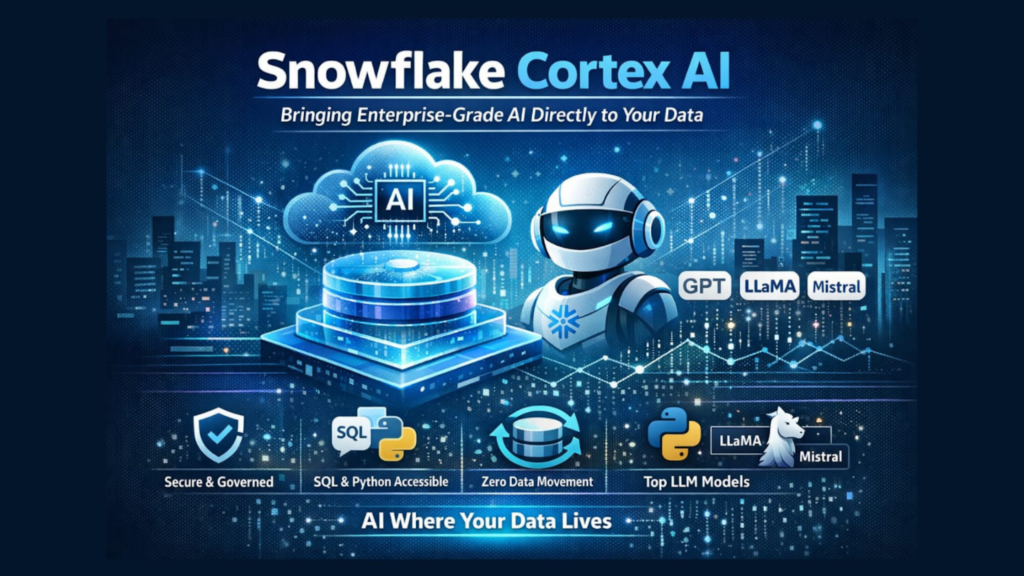
Snowflake’s response is Cortex AI; a fully managed AI and machine learning layer built natively into the Snowflake Data Cloud. Instead of pushing enterprise data into third-party AI platforms, Cortex reverses this model bringing AI directly to the data under the same security and governance controls Snowflake customers already use.
This article examines what Snowflake Cortex AI is, how it operates inside the data platform, why it is important for enterprise adoption, and how it signals a broader shift toward data-native AI as the foundation of future decision-making.
Key Takeaways
- Snowflake Cortex AI brings machine learning and generative AI directly into the Snowflake Data Cloud, eliminating risky and costly data movement to external platforms.
- Built-in governance, role-based access control, and auditing ensure AI usage aligns with security, privacy, and regulatory requirements from day one.
- Organizations can securely use models from Open AI, Meta (LLaMA), and Mistral without separate infrastructure, contracts, or token management.
- Cortex makes advanced AI accessible through familiar SQL and Python workflows, enabling analysts and engineers to apply AI without complex pipelines.
- Snowflake Cortex reflects the broader enterprise trend of embedding AI directly into data platforms, positioning data foundations as the core driver of AI value.
What Is Snowflake Cortex AI?
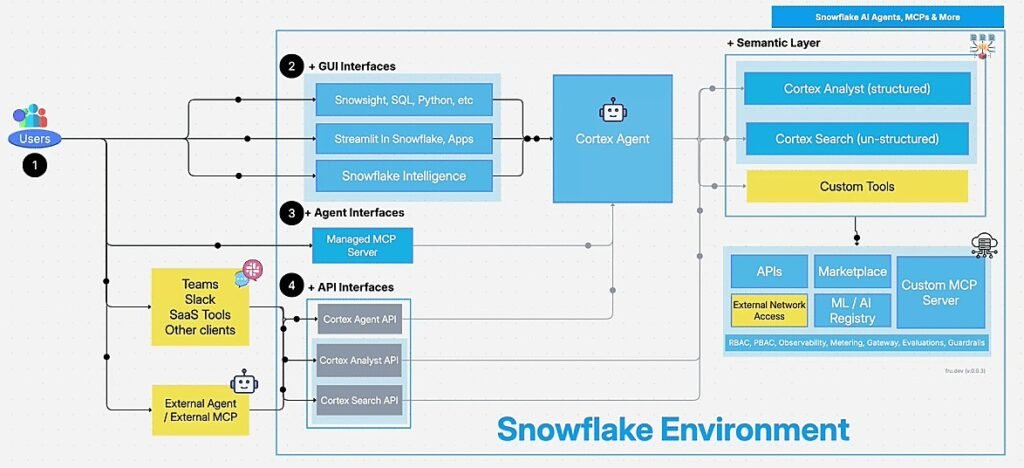
Snowflake Cortex AI is an integrated suite of AI, machine learning, and large language model (LLM) capabilities that runs natively inside the Snowflake platform. It enables businesses to perform tasks such as text summarization, sentiment analysis, classification, forecasting, and natural language querying without moving data outside Snowflake.
Unlike traditional AI workflows that require complex pipelines, external APIs, and custom infrastructure, Cortex is serverless, SQL-accessible, and enterprise-governed.
According to Snowflake’s official documentation, Cortex is designed to make advanced AI “as easy to use as SQL” for analysts, engineers, and data scientists alike.
Why Snowflake Cortex AI is Important for Enterprises
Enterprises are increasingly seeking AI solutions that minimize risk, streamline operations, and integrate seamlessly with existing data infrastructure. Snowflake Cortex AI addresses these needs by combining advanced AI capabilities with the security and governance enterprises require.
1. AI Without Data Movement
Data gravity is real. Enterprises store petabytes of sensitive data in Snowflake, and exporting that data to external AI services introduces security, latency, and compliance risks.
Snowflake Cortex eliminates this issue by running AI workloads where the data already lives. This approach significantly reduces:
- Data leakage risks
- Compliance violations (GDPR, HIPAA, SOC 2)
- Integration complexity
Gartner consistently highlights data movement as one of the biggest hidden costs in enterprise AI adoption.
2. Built-In Access to Leading LLMs
Snowflake Cortex provides access to industry-leading large language models, including:
- OpenAI models
- Meta’s LLaMA models
- Mistral models
These models are securely hosted and managed by Snowflake, allowing organizations to leverage generative AI without negotiating separate vendor contracts or managing token-based billing.
This multi-model approach aligns with a growing enterprise trend: model flexibility over model loyalty, as noted by Forrester’s AI strategy research.
Key Features of Snowflake Cortex AI
Snowflake Cortex AI is designed to make advanced AI capabilities practical and enterprise-ready by embedding them directly into existing data workflows. Its core features focus on accessibility, security, and operational simplicity at scale.
Native SQL and Python Integration
One of Cortex’s strongest advantages is accessibility. AI functions can be invoked directly using SQL or Python, allowing existing data teams to adopt AI without learning entirely new frameworks.
Examples include:
- Text summarization with a single SQL function.
- Sentiment analysis on customer feedback tables.
- Predictive forecasting using built-in ML models.
This significantly lowers the barrier to AI adoption across organizations.
Enterprise-Grade Governance and Security
Snowflake Cortex follows the same role-based access control (RBAC), auditing, and data governance standards as the Snowflake platform itself.
This means:
- No shadow AI usage
- Full visibility into who is using AI and how
- Compliance with enterprise security policies
According to IDC, governance is now a top priority as generative AI adoption scales in regulated industries.
Zero Infrastructure Management
Cortex is fully serverless, meaning organizations do not need to:
- Provision GPUs
- Scale infrastructure manually
- Manage model deployments
Snowflake handles performance optimization, scaling, and cost management behind the scenes, enabling teams to focus on business outcomes instead of infrastructure.
Real-World Use Cases of Snowflake Cortex AI
Snowflake Cortex AI delivers practical, data-driven solutions across industries, helping organizations turn complex datasets into actionable insights. Its versatility allows teams to enhance operations, customer engagement, and strategic decision-making.
Customer Experience & Support
Organizations use Cortex to:
- Summarize customer tickets
- Detect sentiment in reviews
- Identify churn signals
This enables faster response times and more personalized customer interactions.
Financial Services & Risk Analysis
Banks and fintech companies apply Cortex AI for:
- Fraud detection
- Risk scoring
- Regulatory text analysis
Because data never leaves Snowflake, this approach aligns well with strict financial compliance requirements.
Marketing & Content Intelligence
Marketing teams leverage Cortex to:
- Analyze campaign performance
- Generate insights from unstructured text
- Understand customer intent at scale
McKinsey reports that AI-driven marketing analytics can improve ROI by up to 20%.
Snowflake Cortex AI and the Future of Data-Driven AI
Snowflake Cortex represents a broader shift in enterprise AI strategy: AI embedded directly into data platforms, not bolted on as an external service.
As organizations move toward:
- Multi-model AI ecosystems
- Real-time analytics
- Stronger governance requirements
Platforms like Snowflake that unify data, AI, and security will become central to enterprise technology stacks.
Snowflake’s CEO Frank Slootman has repeatedly emphasized that “AI will only be as powerful as the data foundation beneath it” and Cortex is a direct manifestation of that philosophy.
Read More:
- ASI:Cloud Goes Live, Delivering Enterprise‑Grade AI Workloads at Scale
- Genspark AI: Next-Gen Search with Sparkpages for Smarter Research
- Accenture and Anthropic Partnership Boosts Enterprise AI
- Wipro & IBM Join Forces to Drive Enterprise AI Advancements
FAQs
Is Snowflake Cortex AI suitable for non-technical users?
Yes. While data scientists can use advanced features via Python, analysts and business users can access Cortex AI directly through SQL, making it highly accessible without deep ML expertise.
Does Snowflake Cortex AI replace external AI tools?
Not entirely. Cortex complements external AI tools by handling data-native AI tasks. Many enterprises still use external models, but Cortex reduces dependency by covering core analytics and generative use cases internally.
How does Snowflake Cortex AI handle data privacy?
Cortex follows Snowflake’s strict security and governance framework. Data remains within the Snowflake environment, access is role-controlled, and all AI activity is auditable making it suitable for regulated industries.