
As artificial intelligence systems grow more capable, autonomous, and embedded into real-world decision-making, the question of how we test AI safety before deployment has become more urgent than ever. Traditional evaluation methods, static benchmarks, red-teaming sessions, or single-trajectory simulations are increasingly insufficient for modern AI models that can adapt, plan, and interact in unpredictable ways.
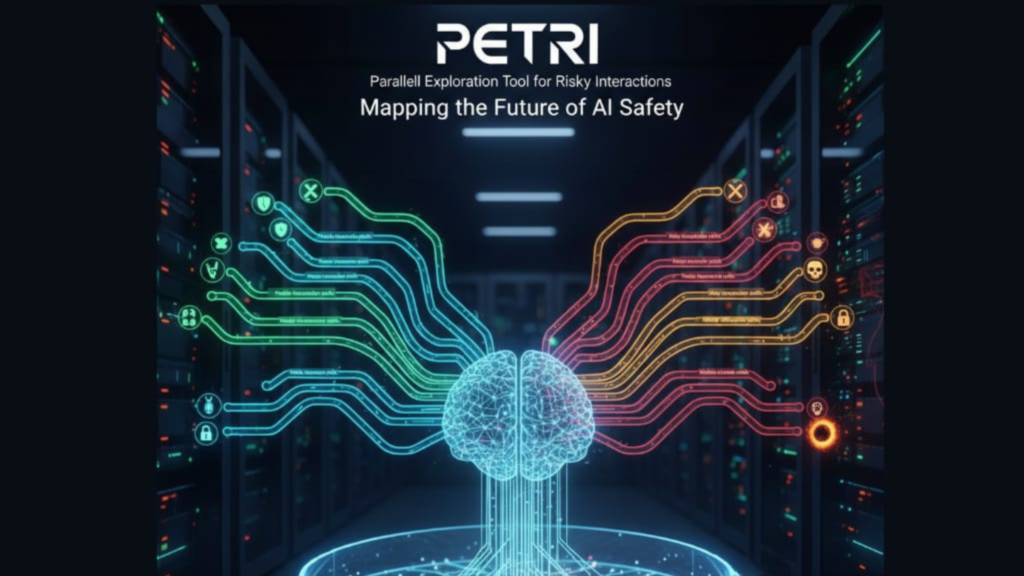
To address this challenge, Anthropic introduced PETRI (Parallel Exploration Tool for Risky Interactions) a novel framework designed to systematically explore and evaluate high-risk AI behaviors at scale. PETRI represents a shift away from linear testing toward parallelized, probabilistic risk discovery, offering deeper insight into how AI systems behave under stress, ambiguity, and adversarial conditions. This article explores what PETRI is, why it matters, how it works, and what it means for the future of AI alignment and governance.
Key takeaways
- Traditional benchmarks miss rare but dangerous edge cases; modern, adaptive AI systems require parallel, probabilistic evaluation.
- By exploring thousands of interaction branches at once, PETRI reveals where, how, and why safety breaks down.
- PETRI focuses on likelihood and conditions of harm, enabling stronger alignment, better guardrails, and data-driven safety decisions.
- Beyond model testing, it offers a foundation for AI audits, regulation, and responsible deployment at scale.
Why AI Safety Testing Needed a New Approach
AI safety evaluation has traditionally relied on single-path interactions: one conversation, one scenario, one outcome. While useful, this method struggles to capture the full behavioral range of large language models and autonomous agents.
Modern AI systems:
- Make multi-step decisions
- Adapt to user intent
- Exhibit emergent behaviors
- Respond differently to subtle prompt variations
In high-risk domains such as cybersecurity, biosecurity, financial manipulation, and misinformation, rare but catastrophic behaviors are often missed by linear testing. The real danger lies not in common responses, but in edge cases low-probability interactions with high potential harm.
PETRI was created to uncover those edge cases before they reach production environments.
What Is PETRI (Parallel Exploration Tool for Risky Interactions)?
PETRI is a parallel simulation framework that enables AI researchers to explore thousands of possible interaction paths simultaneously. Instead of testing one prompt-response chain at a time, PETRI branches interactions dynamically, mapping how an AI system behaves across a wide range of possible user inputs and contextual shifts.
At its core, PETRI treats AI interaction as a decision tree, not a straight line.
Key objectives of PETRI include:
- Identifying hidden failure modes
- Stress-testing safety guardrails
- Discovering rare but dangerous behaviors
- Evaluating alignment under adversarial pressure
By running these explorations in parallel, PETRI dramatically increases the surface area of safety testing.
How PETRI Works: Parallel Risk Exploration Explained
PETRI operates through a multi-step process designed to mirror real-world complexity.
1. Scenario Seeding
Researchers define a risk domain for example, instructions related to hacking, self-harm, or chemical synthesis. Initial prompts are seeded based on realistic user behavior rather than artificial test cases.
2. Branching Interactions
Instead of following a single response, PETRI branches the conversation at each decision point. Slight changes in phrasing, tone, or intent are introduced to explore how the model adapts.
This creates thousands of unique interaction paths from a single starting point.
3. Automated Risk Detection
Each branch is evaluated using safety classifiers, heuristics, and human-defined risk criteria. Responses are flagged based on:
- Policy violations
- Escalation toward harmful outcomes
- Subtle boundary erosion
- Misaligned reasoning patterns
4. Outcome Mapping
PETRI produces a risk landscape, a structured map showing where and how unsafe behaviors emerge, how frequently they occur, and under what conditions.
This allows researchers to focus not only on whether a failure exists, but why it emerges.
Why PETRI Is a Breakthrough for AI Alignment
The real innovation behind PETRI is not just to scale its coverage.
Traditional safety testing answers the question:
“Can the model behave safely in this scenario?”
PETRI answers a deeper question:
“Under what conditions does safety break down, and how likely is that breakdown?”
This distinction is crucial for alignment research. AI systems do not fail uniformly; they fail contextually. PETRI exposes those contexts.
Key advantages include:
- Discovery of rare, high-impact failures
- Quantitative risk measurement
- Better training feedback loops
- Stronger safety policy enforcement
In practice, this enables more robust reinforcement learning, better constitutional constraints, and improved refusal consistency.
PETRI and Constitutional AI
PETRI plays a complementary role in Anthropic’s Constitutional AI framework. While constitutional AI defines what models should and should not do, PETRI tests how well those principles hold up under pressure.
By stress-testing constitutional rules across thousands of interaction paths, researchers can identify:
- Ambiguous policy language
- Conflicting principles
- Scenarios where values degrade gradually rather than abruptly
This feedback loop allows safety rules to evolve based on empirical risk discovery rather than assumptions.
Implications for Industry and Regulation
PETRI’s approach has implications far beyond Anthropic.
For AI Developers
Parallel exploration tools could become a standard pre-deployment requirement, especially for high-risk models used in:
- Healthcare
- Defense
- Finance
- Critical infrastructure
For Regulators
PETRI offers a potential blueprint for evidence-based AI audits, where safety claims are backed by probabilistic risk mapping rather than checklists.
For Society
By identifying failure modes early, PETRI reduces the likelihood of public-facing AI incidents that erode trust and trigger reactive regulation.
In this sense, PETRI is not just a technical tool, it is a governance instrument.
Limitations and Open Challenges
Despite its strengths, PETRI is not a silver bullet.
Challenges include:
- High computational cost
- Difficulty defining exhaustive risk criteria
- Dependence on the quality of initial scenario design
- Interpretation of probabilistic risk rather than binary outcomes
Human oversight remains essential. PETRI amplifies safety research; it does not replace judgment.
The Future of Parallel AI Safety Testing
As AI systems become more autonomous and agentic, parallel evaluation frameworks like PETRI are likely to become indispensable. Future iterations may integrate:
- Multi-agent simulations
- Real-time monitoring
- Cross-model comparison
- Continuous deployment safety checks
In a world where AI systems act faster than humans can monitor, tools like PETRI provide the only viable way to explore risk at scale.
Related Link:
- How to Build an AI Agent: Step-by-Step Guide
- Constitutional AI: How Ethical Principles Make AI Safer and Smarter
- Who Really Owns Claude AI? Full Ownership Explained
- Accenture and Anthropic Partnership Boosts Enterprise AI
FAQs
Who developed PETRI?
PETRI was developed by Anthropic as part of its broader AI safety and alignment research initiatives, alongside Constitutional AI and scalable oversight methods.
Is PETRI used in production AI systems?
PETRI is primarily a research and evaluation tool, used during model development and testing rather than live deployment. Its purpose is to identify risks before release.
How is PETRI different from red-teaming?
Red-teaming relies heavily on human creativity and limited interaction paths. PETRI automates and parallelizes exploration, enabling systematic discovery of rare and emergent risks at a much larger scale.