
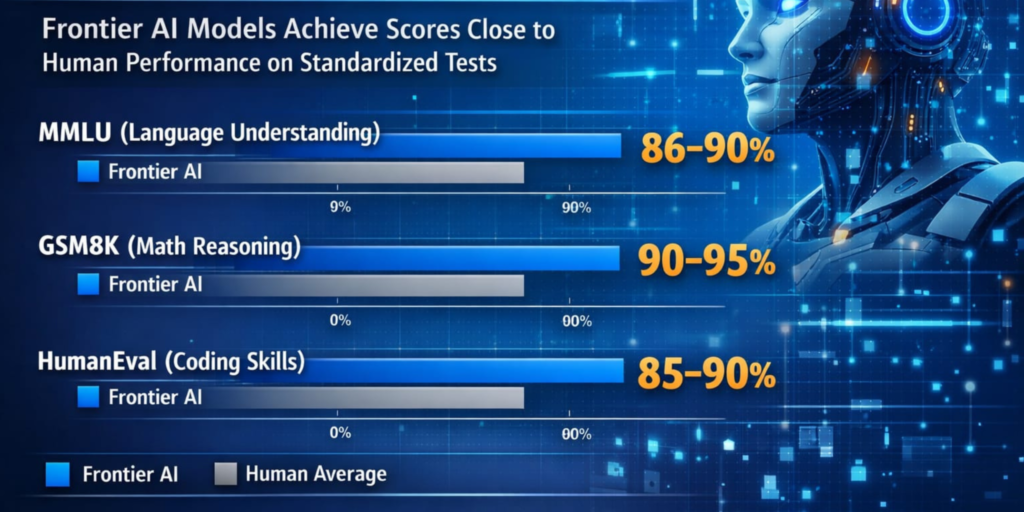
Did You Know? Frontier AI models often achieve benchmark scores close to or exceeding human performance on standardized tests:
- MMLU (Multi-task Language Understanding): ~86–90%
- GSM8K (math reasoning): ~90–95%
- HumanEval (coding): ~85–90% pass rates
(Human levels vary but are roughly similar on these tasks).
Working with Frontier AI in real projects means relying on advanced AI systems and advanced models that sit at the cutting edge of development, where frontier models are designed as general-purpose and foundation models instead of narrow AI built for specific tasks.
These systems push boundaries of what AI technologies can achieve by surpassing earlier benchmarks through stronger reasoning, faster learning, better generalization, and smarter decision-making processes, which is why they are now used across a wide variety of multiple domains.
In practice, using frontier tools often feels closer to working with early forms of artificial general intelligence, because of emergent AI capabilities like planning and code generation, allowing teams to move from idea to execution with less friction. From hands-on testing and industry observation, the biggest value comes when these systems are applied broadly rather than limited to specific tasks, since their strength lies in adapting knowledge across contexts, not just automation.
- How Frontier AI Is Applied in Real-World Scenarios
- Defining the Core Traits of Frontier AI
- 9 Proven Steps to Use It Effectively
- Step 1: Understand the Purpose Before Using the Tool
- Step 2: Choose the Right Platform for Your Needs
- Step 3: Learn the Interface Before Doing Real Work
- Step 4: Improve Results with Better Prompts
- Step 5: Review, Then Refine
- Step 6: Apply Outputs to Real Work
- Step 7: Scale with Advanced Features
- Step 8: Use AI Responsibly and Ethically
- Step 9: Improve Through Continuous Practice
- Practical Advantages That Make Frontier AI Worth Using
- Pitfalls and Real-World Limits of Frontier AI Systems
- Conclusion
- FAQs
How Frontier AI Is Applied in Real-World Scenarios
In real-world use, frontier AI stands out because of its general-purpose capabilities across a wide range of tasks, from creative generation and content generation to problem-solving, planning, coding, and writing code that works across products. Teams adopt it by leveraging advanced AI systems trained at huge scale on massive datasets, combining text, images, and logic through multimodal architectures to improve performance.
In practice, tools like ChatGPT and GPT-4 are used for workflow automation in education, healthcare, and industries where speed and adaptability matter, but value comes only when paired with best practices, strong AI safety controls, and responsible deployment to reduce risk and maximize potential.
Defining the Core Traits of Frontier AI

What sets these models apart from earlier AI products is their complexity and the way emergent behaviors appear during training, leading to unexpected skills like deeper reasoning or adaptive problem-solving without explicit rules. These characteristics allow impact at the level of societal impact, influencing defense, public services, and innovation across industries, while also raising questions about governance as capabilities keep emerging. When applied carefully, frontier systems reshape how organizations think about automation and intelligence, but misuse or poor oversight can undermine trust, making safety frameworks essential.
9 Proven Steps to Use It Effectively
Frontier AI models are powerful tools designed to support complex thinking, automation, and decision-making across industries. Using them effectively requires clarity of purpose, structured interaction, and responsible application rather than simple trial-and-error.
Step 1: Understand the Purpose Before Using the Tool
Effective usage of Frontier AI starts by understanding why you are using it. These advanced AI models perform best when the problem is well-scoped. Whether the focus is high-quality content, cybersecurity threats, analyzing threats, or guiding business decisions, defining intent improves outcomes and avoids wasted effort. Teams that treat Frontier AI as decision support instead of a shortcut see more consistent results.
Step 2: Choose the Right Platform for Your Needs
A reliable Frontier AI platform should come from a trusted provider such as an AI research lab, enterprise AI platform, or developer service. Strong platforms offer secure environments, updated models, and responsible-use safeguards. Typical onboarding includes an email account, sign up, verification, agreement to usage policies, and structured access management to ensure platform reliability and compliance.
Step 3: Learn the Interface Before Doing Real Work
Most Frontier AI platforms focus on usability through a user-friendly interface like a chat window, workspace, or dashboard. Using natural language for communication helps beginners adapt quickly. Simple actions such as typing questions, issuing instructions, and assigning tasks mirror human assistant interaction, which improves interface design and overall usability.
Step 4: Improve Results with Better Prompts
The Frontier AI output quality depends heavily on prompt writing. Clear structure, clear explanation, defined user intent, and context inclusion all matter. Adding format specification and tone control for example in a cybersecurity blog using simple language leads to accurate responses, relevant output, usable results, and better prompt clarity overall.
Step 5: Review, Then Refine
Every AI response should go through output review for accuracy, clarity, and relevance. Frontier AI supports iterative improvement, allowing follow-up questions, edit requests, and constraints. This step-by-step refinement process is how teams consistently achieve professional results and high-quality outcomes.
Step 6: Apply Outputs to Real Work
Once a refined output is ready, it can support real-world tasks like blog publishing, report generation, marketing strategies, security data analysis, and research support. Used correctly, a Frontier AI assistant drives productivity enhancement while respecting human expertise, ensuring practical application and better workflow efficiency.
Step 7: Scale with Advanced Features
More mature teams rely on advanced features such as APIs and automation. These tools support technical users, organizations, and developers through application integration with websites and internal systems. By using structured requests and proper data handling, Frontier AI enables process automation, system monitoring, trend analysis, and large-scale operations with higher efficiency.
Step 8: Use AI Responsibly and Ethically
Strong results require responsible use and ethical usage aligned with Frontier AI guidelines. Avoid exposing sensitive data or confidential information, prioritize output verification, and follow legal standards and ethical standards. Best practices from leading AI organizations emphasize human decision-making, accountability, professional judgment, and regulatory compliance.
Step 9: Improve Through Continuous Practice
Long-term success comes from continuous use and regular usage. Teams develop effective communication with better Frontier AI interaction, stronger prompting skills, and a clearer understanding of model strengths and limitations. This continuous learning approach delivers long-term value, better outputs, safer usage, reliable systems, and measurable performance improvement.
Practical Advantages That Make Frontier AI Worth Using
Frontier models and generative AI deliver clear value when used with intent. Their versatility and powerful capabilities help businesses, researchers, and creators improve efficiency, drive innovation, and support smarter decision-making through higher accuracy and better generalization than older models. In practice, handling large-scale data and sophisticated tasks from natural language understanding and computer vision to multi-modal reasoning is where they stand out.
Their scalability across applications and industries allows fine-tuning for task adaptation without constant full retraining, which boosts AI-driven insights, automation, and enhanced decision-making. Teams that plan adoption carefully see stronger model performance, clearer enterprise use cases, a sustainable competitive edge, deeper personalization, and measurable gains in operational efficiency, especially when these intelligent systems are paired with human oversight.
Pitfalls and Real-World Limits of Frontier AI Systems
Working with AI frontier models in production quickly shows that operationalizing them comes with real challenges. High costs appear early during training and deployment, as large AI models demand massive computational resources, driving up infrastructure costs and energy consumption. Beyond scale, ethical issues such as bias and societal biases embedded in training data can result in unfair outcomes or discriminatory outcomes. Another practical concern is hallucination and inaccuracy, where models generate false information or misleading information with high confidence generation.
There are also serious security risks and privacy risks, including sensitive information leakage, while regulatory challenges around compliance with evolving laws like the EU AI Act, GDPR, and data protection policies continue to grow. Finally, the lack of transparency and limited explainability of black box models including reasoning opacity and decision-making opacity creates accountability problems in healthcare and finance, increasing organizational risk, weakening governance, and raising long-term trust issues.
Conclusion
From my hands-on work with Frontier AI in real products, I’ve seen how this new frontier of machine intelligence is shaped by foundation models trained on massive datasets and designed for a wide range of tasks. What makes it stand out is its scale and general-purpose adaptability, which power advanced AI and advanced AI systems to transform workflows, automate decision-making, and support organizations across industries. In practice, cutting-edge innovation comes from emergent behaviors that unlock transformative benefits and create new opportunities, delivering the full benefits when teams focus on best practices and a key goal: real value, not hype.
For more tech, AI, cyber security, and digital marketing insights, visit Daily Digital Grind. If you’re interested in contributing, check out our Write for Us page to submit your guest posts!
FAQs
What is Frontier AI?
Frontier AI in real projects means relying on advanced AI systems and advanced models that sit at the cutting edge of development, where frontier models are designed as general-purpose and foundation models instead of narrow AI built for specific tasks.
How is a Frontier AI different from the AI chatbot?
Frontier AI can reason through complex, multi-part problems while chatbot follows a simple script to answer questions.
What’s the Difference Between Frontier AI and Narrow AI?
Frontier AI refers to general-purpose, cutting-edge systems that can handle many different kinds of tasks like reasoning, planning, coding, and language understanding all in one model. Narrow AI, by contrast, is designed for one specific task only (e.g., image recognition or translation) and doesn’t generalize beyond that.