
Did You Know? According to IBM’s Cost of a Data Breach Report 2024, the global average cost of a data breach has reached $4.45 million, the highest on record, with insecure networks cited as a primary attack vector. In this environment, trust is no longer claimed; it is verified. SOC 2 audits have emerged as a critical proof point, examining how organizations design and operate real-world network security controls.
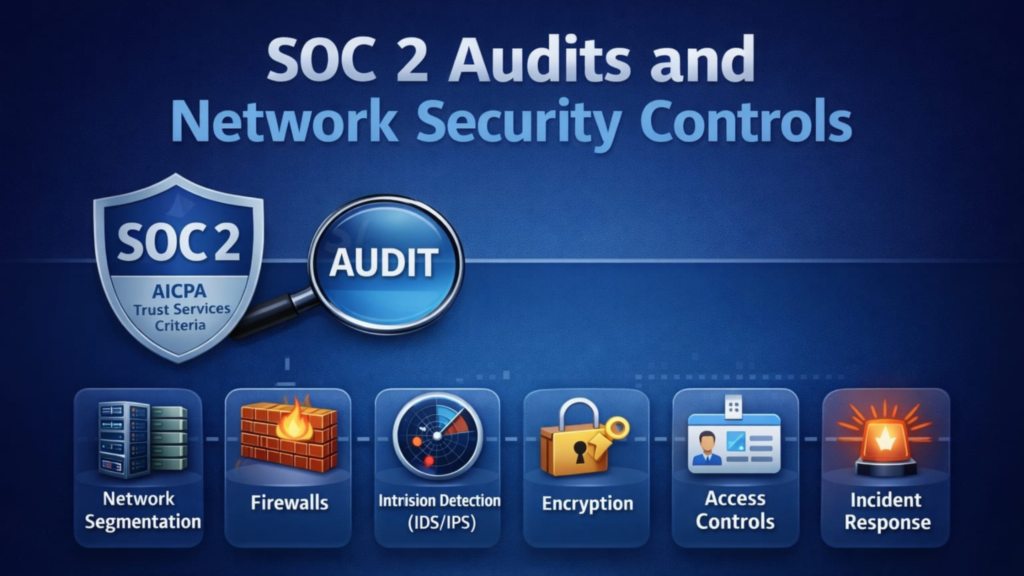
As defined by the AICPA’s Trust Services Criteria, SOC 2 goes beyond policy documents to assess firewalls, access controls, monitoring, and incident response. For SaaS, fintech, and cloud-first companies, these evaluations now define operational credibility not just compliance.
- Understanding SOC 2 and Network Security
- The Auditor’s Perspective: Risk First, Controls Second
- Key Network Security Controls Evaluated in SOC 2 Audits
- Monitoring, Logging, and Incident Response
- SOC 2 Type I vs Type II: Why Duration Matters
- Why Network Security Evaluation Matters Beyond Compliance
- The Future of Network Security in SOC 2
- Final Thoughts
- FAQs
Understanding SOC 2 and Network Security
SOC 2 (System and Organization Controls 2) is a compliance framework developed by the American Institute of Certified Public Accountants (AICPA). It evaluates how organizations protect customer data based on five Trust Services Criteria:
- Security
- Availability
- Processing Integrity
- Confidentiality
- Privacy
At the core of SOC 2 lies the Security principle, which focuses heavily on network-level protections. This includes safeguards that prevent unauthorized access, detect malicious activity, and ensure secure communication between systems.
Network security controls form the first line of defense. If these controls fail, even the most sophisticated application-level protections become ineffective.
The Auditor’s Perspective: Risk First, Controls Second
SOC 2 audits are not about checking whether a company owns security tools, they are about how well risks are understood and managed.
Auditors begin by assessing:
- The organization’s network architecture
- Data flow across internal and external systems
- Exposure to internal and external threats
Once risks are identified, auditors evaluate whether network security controls are appropriately designed to mitigate those risks and whether they operate consistently over time (especially in SOC 2 Type II reports).
This risk-based approach ensures that controls are not theoretical but practical and effective.
Key Network Security Controls Evaluated in SOC 2 Audits
SOC 2 auditors examine network security controls to determine whether they are appropriately designed to mitigate identified risks and consistently enforced over time. These controls form the technical backbone of the Security Trust Services Criterion and are critical to preventing unauthorized access and data breaches.
Network Segmentation and Access Boundaries
Auditors closely examine how networks are segmented to limit access. Proper segmentation ensures that sensitive systems are isolated from less secure environments.
They assess:
- Separation between production, development, and testing environments
- Isolation of critical databases
- Restricted lateral movement within the network
Effective segmentation minimizes the blast radius of a security incident.
Firewalls and Traffic Filtering
Firewalls remain a cornerstone of SOC 2 network security evaluations. Auditors do not just verify their existence; they examine configuration and governance.
Key focus areas include:
- Firewall rule management and approval processes
- Default-deny configurations
- Regular review of inbound and outbound traffic rules
Misconfigured firewalls are among the most common audit findings, making this control especially critical.
Intrusion Detection and Prevention Systems (IDS/IPS)
SOC 2 audits evaluate how organizations detect and respond to suspicious network activity.
Auditors look for:
- Real-time monitoring of network traffic
- Alerts for abnormal patterns or known attack signatures
- Defined response procedures when threats are detected
The emphasis is not only on detection, but on the organization’s ability to act quickly and effectively.
Secure Network Communication and Encryption
Data in transit is a prime target for attackers. SOC 2 auditors assess how organizations protect network communications through encryption.
They evaluate:
- Use of industry-standard encryption protocols (e.g., TLS)
- Secure VPNs for remote access
- Encryption of internal service-to-service communication
Weak or outdated encryption protocols can result in audit exceptions, even if other controls are strong.
Identity, Authentication, and Network Access Control
Network security is inseparable from identity management. Auditors assess how users and systems authenticate before gaining network access.
Key elements include:
- Multi-factor authentication (MFA)
- Role-based access controls
- Least-privilege network permissions
Auditors also review how access is revoked when employees leave or roles change, as delayed deprovisioning is a common risk.
Monitoring, Logging, and Incident Response
A secure network is not static; it must be continuously observed. SOC 2 audits place heavy emphasis on monitoring and logging mechanisms.
Auditors examine:
- Centralized log collection
- Retention policies for network logs
- Regular review of security events
Equally important is incident response readiness. Organizations must demonstrate documented procedures for identifying, escalating, and resolving network security incidents.
SOC 2 Type I vs Type II: Why Duration Matters
One critical distinction in SOC 2 audits is between Type I and Type II reports.
- Type I evaluates whether network security controls are properly designed at a specific point in time.
- Type II assesses whether those controls operate effectively over an extended period (usually 6–12 months).
For network security, Type II reports carry significantly more weight. They prove that controls are not just implemented but consistently enforced.
Why Network Security Evaluation Matters Beyond Compliance
SOC 2 network security evaluations are not merely compliance exercises. They influence:
- Customer trust and enterprise sales cycles
- Vendor risk assessments
- Cyber insurance eligibility
- Regulatory readiness
In an era of supply-chain attacks and zero-trust architecture, organizations with mature network controls gain a competitive advantage.
SOC 2 signals that security is embedded into operational culture, not bolted on for audits.
The Future of Network Security in SOC 2
As cloud-native and hybrid infrastructures evolve, SOC 2 audits are adapting. Auditors increasingly assess:
- Zero Trust network models
- Cloud-native firewalling and micro segmentation
- Automated security policy enforcement
Organizations that align network security with modern architectures are better positioned to meet future audit expectations.
Final Thoughts
SOC 2 audits do more than validate security claims; they expose how seriously an organization treats risk, resilience, and responsibility. Network security controls sit at the heart of this evaluation, forming the foundation upon which trust is built.
For organizations seeking long-term credibility, investing in robust, well-documented, and consistently enforced network security controls is not optional, it is essential.
FAQs
Does SOC 2 require specific network security tools?
No, SOC 2 does not mandate specific tools. Instead, it evaluates whether the chosen controls effectively mitigate identified risks. The focus is on outcomes, not vendors.
Are cloud networks evaluated differently in SOC 2 audits?
Yes, Auditors assess shared responsibility models, cloud security configurations, and provider controls. Organizations must demonstrate how they secure their portion of the cloud environment.
How often should network security controls be reviewed for SOC 2?
Best practice is continuous monitoring with formal reviews at least quarterly. Regular reviews strengthen audit outcomes and reduce the risk of control failures.