
For years, large language models (LLMs) have been evolving at breakneck speed. From GPT-4 to Claude and open-source models like LLaMA, the intelligence of AI systems has rapidly improved. Yet beneath this progress lies a quiet but critical limitation; models still struggle to interact reliably with external tools, data sources, and real-world systems in a standardized way.
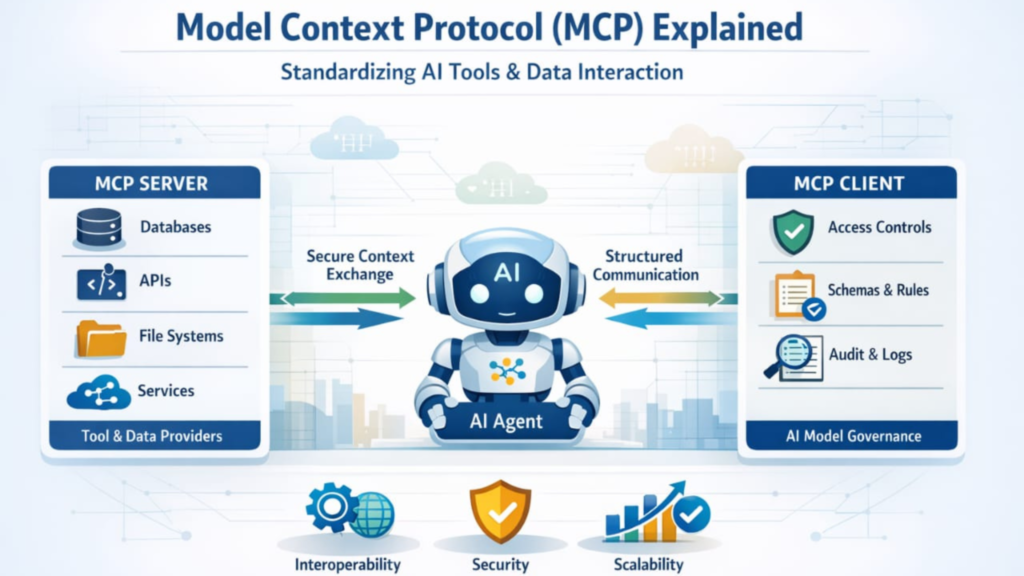
This is where the Model Context Protocol (MCP) enters the conversation.
MCP is not a new model, framework, or API wrapper. Instead, it represents a standardized protocol for how AI models receive, interpret, and act on contextual information from tools, databases, files, and services. As AI systems increasingly function as agents rather than passive chatbots, MCP is emerging as a foundational layer for safe, scalable, and interoperable AI. This article explores what MCP is, why it matters, how it works, and its implications for the future of AI systems.
Key Takeaways
- Model Context Protocol (MCP) standardizes how AI models interact with tools, APIs, and data, replacing fragile prompt-based integrations with structured, machine-readable context.
- MCP is essential for modern AI agents, enabling reliable task execution, reduced hallucinations, and consistent behavior across different environments.
- Security and governance are core benefits of MCP, offering explicit permissions, auditability, and compliance support for enterprise and regulated industries.
- As AI systems scale, MCP-like protocols will become foundational, shaping the future of interoperable, secure, and production-grade AI deployments.
- What Is the Model Context Protocol (MCP)?
- Why the Model Context Protocol (MCP) Is Crucial for Modern AI Systems
- How the Model Context Protocol Works
- Security and Governance Benefits of Model Context Protocol
- Model Context Protocol and the Future of AI Agents
- Industry Adoption and Momentum Behind Model Context Protocol
- Final Thoughts
- FAQs
What Is the Model Context Protocol (MCP)?
The Model Context Protocol (MCP) is a structured communication standard that defines how external tools and systems provide context to AI models and how models understand, reason about, and use that context.
In simpler terms, MCP answers a critical question:
How should an AI model be told what tools exist, what data is available, and how it is allowed to use them?
Rather than embedding tool logic directly into model prompts or relying on ad-hoc integrations, MCP introduces a clear, machine-readable contract between:
- AI models (like Claude or GPT)
- Tool providers (databases, APIs, file systems)
- Execution environments (local apps, servers, or secure sandboxes)
Anthropic formally introduced MCP to support tool-using AI Agent, particularly within Claude’s ecosystem, but its design principles are model-agnostic and increasingly influential across the industry.
Why the Model Context Protocol (MCP) Is Crucial for Modern AI Systems
As AI moves beyond simple conversations, the need for standardized interaction with tools and data becomes critical. MCP ensures that AI agents operate safely, reliably, and predictably in complex environments.
1. The Shift from Chatbots to AI Agents
Early LLMs were conversational. Modern AI systems are task-oriented agents that:
- Query databases
- Read and write files
- Call APIs
- Execute workflows
- Make conditional decisions
Without a protocol like MCP, these actions rely on brittle prompt engineering and custom glue code.
MCP provides predictability and structure, enabling AI systems to behave consistently across environments.
2. Reducing Prompt Fragility and Hallucinations
When models are given unstructured context, they often:
- Misinterpret tool capabilities
- Assume access they do not have
- Hallucinate results
MCP enforces explicit declarations of:
- Available tools
- Input/output schemas
- Permissions
- Constraints
This dramatically reduces ambiguity and improves reliability, a key requirement for enterprise and regulated use cases.
3. Interoperability Across Tools and Vendors
Today, every AI platform implements tools differently. MCP acts as a universal language, allowing:
- One tool to work with multiple models
- One model to switch between tools without rewrites
- Easier vendor-neutral AI architectures
This mirrors how HTTP standardized the web or how SQL standardized database queries.
How the Model Context Protocol Works
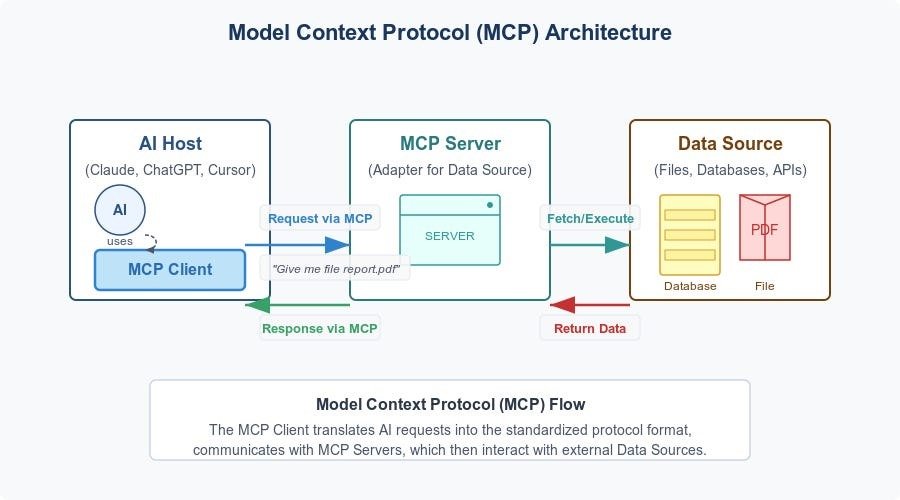
At its core, MCP introduces a client-server architecture:
MCP Servers
These expose tools, data sources, or capabilities. Examples include:
- A local file system
- A database query service
- A GitHub repository
- An internal company API
Each server describes:
- What it can do
- How it can be called
- What data it returns
- What permissions are required
MCP Clients (AI Models)
The model does not “guess” how to use a tool. Instead, it:
- Reads the structured tool definition
- Determines whether the tool is relevant
- Calls the tool using the defined schema
- Receives results in a predictable format
This separation ensures control, safety, and auditability.
Security and Governance Benefits of Model Context Protocol
One of MCP’s most important contributions is AI governance.
With MCP:
- Models cannot access tools unless explicitly granted
- Sensitive data sources can be sandboxed
- Actions can be logged and audited
- Enterprises can enforce compliance policies
This is especially critical for:
- Healthcare
- Finance
- Legal systems
- Government and defense applications
In these domains, how an AI accesses information is as important as what it outputs.
Model Context Protocol and the Future of AI Agents
MCP is closely aligned with the rise of:
- Autonomous AI agents
- Multi-step reasoning systems
- Long-running workflows
- Human-in-the-loop decision systems
As agents grow more capable, unstructured context becomes a liability. MCP provides the scaffolding needed to scale intelligence responsibly.
Industry trends suggest MCP-style protocols will become:
- Default in enterprise AI platforms
- Required for regulated deployments
- A baseline for agent interoperability
Much like containerization transformed software deployment, context protocols will transform AI deployment.
Industry Adoption and Momentum Behind Model Context Protocol
While Anthropic pioneered MCP’s formalization, similar ideas are appearing across:
- OpenAI’s tool-calling schemas
- LangChain and agent frameworks
- Open-source agent runtimes
- Secure enterprise AI platforms
This convergence signals a broader realization: models alone are not enough. The future belongs to systems that combine intelligence with structured, governed context.
Final Thoughts
The Model Context Protocol may not generate headlines like new models or billion-dollar funding rounds, but its importance cannot be overstated. Without standards for context, AI systems remain fragile, unsafe, and difficult to scale.
MCP represents a quiet but decisive step toward mature, interoperable, and governable AI. As AI agents become embedded in critical workflows, protocols like MCP will define not just how models think but how they responsibly act in the real world.
In the long run, the future of AI will be shaped as much by protocols as by parameters.
Related Link:
- How to Build an AI Agent: Step-by-Step Guide
- Anthropic Launches Agent Skills Open Standard to Power Interoperable AI Agents
- Who Really Owns Claude AI? Full Ownership Explained
- Accenture and Anthropic Partnership
FAQs
Is Model Context Protocol (MCP) only for Claude or Anthropic?
No, while Anthropic introduced MCP, it is model-agnostic by design. The protocol principles can be applied to any LLM, including open-source and proprietary models.
Does MCP replace APIs or plugins?
No, MCP does not replace APIs. It standardizes how AI models interact with APIs, making integrations more reliable, secure, and reusable.
Why is MCP important for enterprise AI adoption?
Enterprises require control, auditability, and security. MCP provides explicit permissions, structured context, and predictable behavior all essential for production-grade AI systems.