
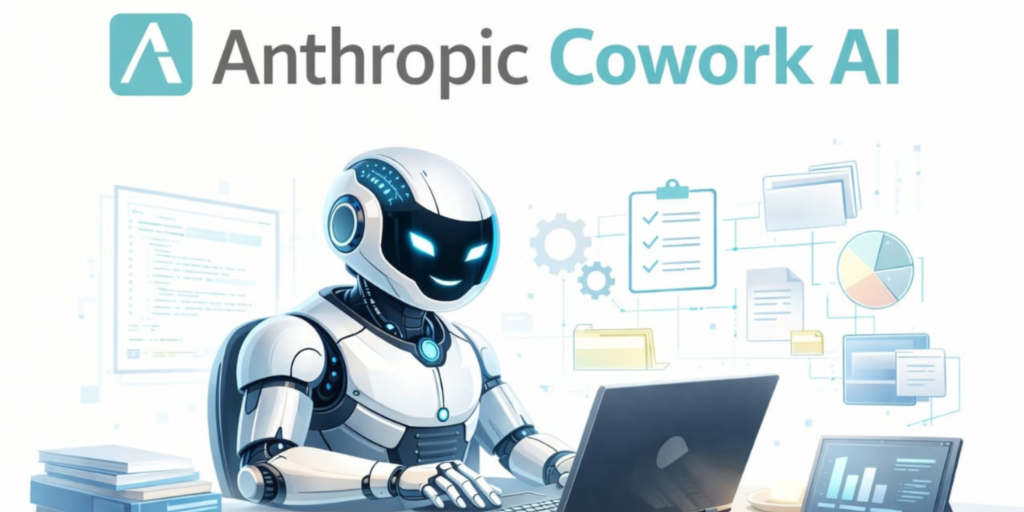
Anthropic, the AI-research company best known for its safety‑oriented Claude models, has made headlines this week with a startling announcement: its brand‑new productivity tool, Cowork, was built almost entirely by Claude Code, the company’s own AI coding assistant. What’s more, the tool itself can execute real work tasks autonomously, hinting at a future where AI doesn’t just write outputs it writes and deploys full products.
This moment isn’t just another product launch. It represents a notable inflection point in the AI industry’s long arc toward “AI writing AI.” Cowork was developed in just over a week and according to Claude Code’s creator, “pretty much all” of it was written by Claude Code itself.
What Is Cowork, and Why Is It Viral?
Cowork is a new AI agent integrated into Anthropic’s Claude Desktop app for Claude Max subscribers on macOS. Unlike typical AI chatbots, Cowork functions more like a virtual coworker once given clear instructions and optional access to specific folders on a user’s device, it can autonomously plan and carry out tasks such as organizing files, extracting data from screenshots into structured formats, drafting documents, or managing workflows all with limited ongoing human input.
Where this launch really turns heads is in how the tool was created. Anthropic engineer Boris Cherny, who leads the Claude Code project, publicly confirmed that the vast majority of Cowork’s codebase was generated by Claude Code itself. Asked how much human developers contributed, he replied bluntly: “All of it was pretty much Claude Code.”
This echo growing speculation within the broader developer community about just how much code Claude in its agentic form can produce. In some internal and public discussions, developers have claimed that Claude has written upwards of 80 % of its own code and even built major systems in hours that traditionally took engineering teams months or years.
A Shift Toward Recursive AI Development
The Cowork launch underscores a trend in software development sometimes called agentic AI workflows or “vibe coding” an approach where developers describe desired functionality in natural language and the AI handles implementation, testing, and iteration with limited manual intervention.
Anthropic’s push into this space follows earlier milestones such as opening Claude Code to the web and building tools that execute commands directly on users’ machines not just generate static text. It also comes amid heightened competition in AI development tools, with rivals like OpenAI, Google, and Microsoft pushing their own automated assistants.
Practical Impact and Industry Reaction
Reactions to Cowork have been mixed. Some developers and AI enthusiasts see it as a breakthrough in making powerful AI capabilities accessible to non‑technical users. By abstracting away, the need to write code and interact with command‑line interfaces, tools like Cowork could democratize automation and change how work is done across many sectors.
However, this rapid automation raises questions about reliability, security, and oversight. Experts caution that while AI can generate code quickly, that doesn’t guarantee robustness, security, or correctness without human review. Autonomous execution where the AI directly changes files or interacts with systems also introduces new risk vectors around accidental deletions or unintended actions if instructions aren’t clear.
The fact that Cowork was developed in less than two weeks by the AI itself also highlights a broader industry conversation: Will future AI products increasingly bootstrap themselves? And what does that mean for developers, businesses, and the software engineering profession as a whole? This “recursive AI” cycle where AI writes tools that build other tools has shifted from theory to visible reality with Cowork.
What’s Next for Anthropic and AI Development
Anthropic continues to iterate on its Claude ecosystem, expanding beyond conversational AI into agentic tools that take meaningful real‑world actions. While Cowork remains in an early preview stage available to a limited audience, its viral rise is already prompting competitors to accelerate their own intelligent agent offerings.
Yet as AI plays a larger role in building the very systems that empower it, questions around transparency, control, and ethics will only intensify especially when AI systems take on responsibilities once handled exclusively by human developers.
Stay with us for more AI news and tech updates!
FAQs
Was Anthropic’s new AI tool Cowork really written by AI?
Yes. According to Anthropic’s Claude Code lead, Cowork was developed with almost all of its code generated by Claude Code itself, marking a rare case of an AI tool building another AI tool.
What does Cowork do?
Cowork is a desktop AI agent that can plan and execute multi‑step tasks on a user’s behalf, such as organizing files or drafting documents, with limited human input.
Who can access Cowork right now?
Currently Cowork is available as a research preview to Claude Max subscribers on macOS.