
The digital storefront is constantly under assault. New breaches, ransomware attacks, and vulnerabilities in plugins or APIs can strike at any time, many online stores still rely on old perimeter-based defenses assuming data and users stay behind a firewall. Effective e-commerce network security and cybersecurity for online stores are more critical than ever.
According to the 2025 IBM Cost of a Data Breach Report, the average breach cost reached around USD 4.44 million, with supply chain and third-party vendor incidents among the most expensive. Even popular platforms aren’t safe; over 250 Adobe Commerce/Magento stores were compromised in just 24 hours in late 2025. Hybrid cloud, multi-cloud adoption, and AI are shaping e‑commerce; identity-first security, continuous threat detection, strict vendor controls, and resilience-by-design have become key.
Key Takeaways
- E-commerce security now demands a multi-layered, identity-first approach, combining HTTPS, MFA, least-privilege access, and continuous monitoring to counter evolving threats.
- Third-party and supply-chain vulnerabilities remain one of the most exploited attack paths, making strict plugin reviews, API security, and vendor governance essential.
- The rise of credential theft, ransomware, and e-skimming makes regular patching, segmentation, WAF deployment, and secure payment processing indispensable for online stores.
- Human behavior is still a major vulnerability; employees and customers must be trained to detect phishing, social engineering, and unsafe password practices.
- Strong resilience measures, frequent security audits, isolated backups, and a formal incident response plan are critical to reducing the impact of breaches and ensuring business continuity.
- Common Threats to E‑commerce Sites
- How to Protect Online Stores from Attacks
- 1. Employ SSL/TLS Encryption and HTTPS
- 2. Utilize PCI-DSS Compliant, Secure Payment Gateways
- 3. Enforce Strong Authentication and Access Controls
- 4. Deploy Firewalls and Web Application Firewalls – WAFs
- 5. Keep Systems Updated & Conduct Regular Security Audits
- 6. Segment Your Network & Secure Third‑Party Integrations / APIs
- 7. Adopt AI/ Machine Learning for Real‑Time Threat Detection
- 8. Train Employees and Customers; Make it a Security‑First Organization
- 9. Keep Backups & Prepare an Incident Response Plan
- Why These Security Measures Are Important
- Final Thoughts
- FAQs
Common Threats to E‑commerce Sites
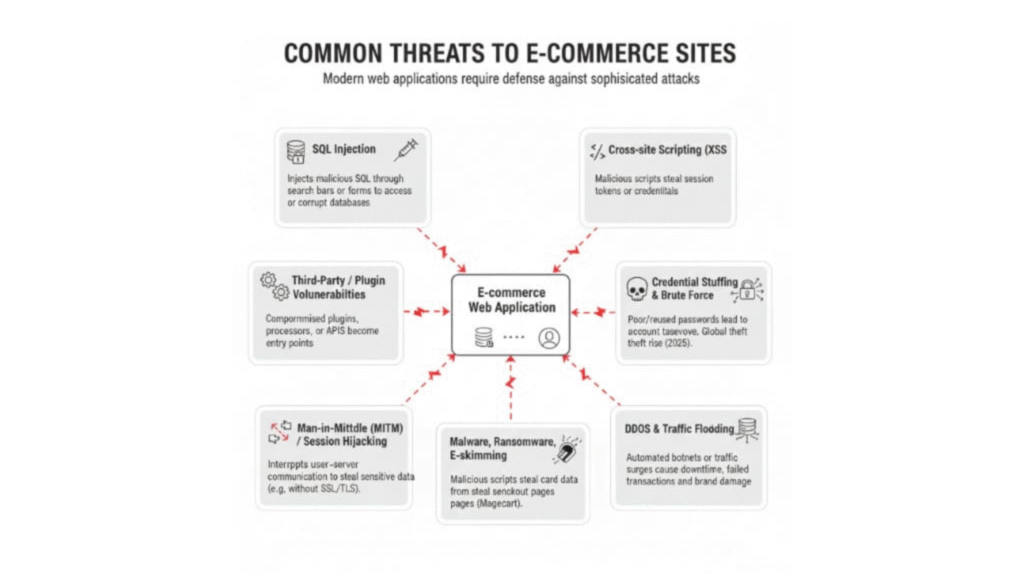
Modern e-commerce web applications should be able to defend themselves against a wide range of cyberattacks. The most common and dangerous are listed below:
- SQL Injection: The attacker injects malicious SQL through search bars or forms to get access to or corrupt databases.
- Cross-site scripting: Malicious scripts injected into pages steal session tokens or credentials as users interact with compromised pages.
- Third‑Party / Plugin Vulnerabilities & Supply‑Chain Risks: Compromised plugins, payment processors, or external APIs can become an entry point without noise. Recent supply‑chain attacks have backdoored hundreds of e‑commerce sites.
- Credential Stuffing & Brute Force: Poor or reused passwords allow attackers to take over customer or administrative accounts. In 2025, credential theft began an upward spiral across the globe.
- Man-in-the-Middle Attacks & Session Hijacking: In the absence of appropriate encryption, like SSL/TLS, attackers can intercept or hijack user-server communications to steal sensitive data.
- Malware, Ransomware, E‑skimming (Magecart): Malicious scripts that target checkout pages or payment forms can steal card data in real time.
- DDoS & Traffic Flooding: Application downtime, failed transactions, and brand damage are caused by automated botnets or large-scale traffic surges flooding servers.
How to Protect Online Stores from Attacks
Here’s a practicable checklist-a blueprint of security measures e‑commerce businesses should adopt now:
1. Employ SSL/TLS Encryption and HTTPS
Make sure the entire site uses SSL/TLS, especially checkout and login pages, to encrypt data that moves between users and your servers. This will safely encrypt such sensitive information as payment details or personal data against interception and instill confidence due to a secure‑site padlock.
2. Utilize PCI-DSS Compliant, Secure Payment Gateways
Never store raw credit card data on your servers. Rely on industry-standard compliant payment gateways, namely, PCI‑DSS. Most of them provide tokenization (data replaced by tokens) and other security layers, like 3D Secure, to reduce fraud.
3. Enforce Strong Authentication and Access Controls
These steps drastically reduce the risk of account takeover and unauthorized access.
- Create strong, unique passwords for administration panels, databases, and any inner tool.
- Enable Multi‑Factor Authentication for administrative and critical user accounts.
- Apply the principle of least privilege by granting only the minimum required access.
4. Deploy Firewalls and Web Application Firewalls – WAFs
A WAF examines HTTP/HTTPS traffic to filter out malicious requests. Block SQL injections, XSS, suspicious bots, and known exploit patterns. Combine WAF with network‑level firewalls to regulate inbound/ outbound traffic and mitigate volumetric attacks such as DDoS.
5. Keep Systems Updated & Conduct Regular Security Audits
Attackers seek to take advantage of outdated software and unpatched vulnerabilities. Keep the CMSs, plugins, themes, and server software patched regularly. Perform periodic vulnerability scans and security audits to find issues before the attackers can.
6. Segment Your Network & Secure Third‑Party Integrations / APIs
Segment sensitive systems, like databases and admin consoles, from the publicly accessible pieces; web servers to checkout modules. Perform security audits on third-party integrations, plugins, payment APIs, and analytics. Use secure authentication like OAuth 2.0, tokenization, and permission limits.
7. Adopt AI/ Machine Learning for Real‑Time Threat Detection
AI/ML-powered monitoring can identify such abnormal patterns-suspicious login behavior, for example, and bot-driven pressure on checkout forms-much faster than humanly possible. These can flag the abnormalities, block bots, and send alerts in real time to security teams-a great advantage in this fast-moving threat landscape.
8. Train Employees and Customers; Make it a Security‑First Organization
Security is not just tech-human behavior matters. Train your employees to spot phishing, social engineering, suspicious links, or plugins. Encourage customers and staff to use unique passwords and enable MFA wherever possible.
9. Keep Backups & Prepare an Incident Response Plan
Even the best defenses can be breached. Keep regular, isolated backups of site data and databases. Have a clear incident response plan; define who responds, how breaches will be contained, how to notify affected users, restore systems, and analyze root causes.
Why These Security Measures Are Important
Cyberattacks are getting more frequent, sophisticated, and costly. It’s not an IT job to defend your network; it’s a protection of revenue, reputation, and customer trust.
- The average cost of a data breach rose to approximately USD 5.08 million in 2025, showing how financially crippling certain incidents could be. Supply-chain and third-party vendor breaches remain some of the most costly, sometimes as expensive as more direct attack vectors.
- Recent incidents, like the compromise of more than 250 Magento/Adobe Commerce stores in just one night, prove that bad actors actively target e‑commerce platforms with automated large‑scale attacks.
- By 2025, credential theft and phishing remained two of the most prevalent initial attack vectors, while strong authentication and vigilance were among the most pressing needs.
These data show that network security for e‑commerce isn’t just an IT concern; it is a business-critical necessity. A single breach can erode customer trust, incur heavy financial losses, and damage brand reputation.
Final Thoughts
E-commerce businesses are still under constant assault in 2025 and beyond. A multi-layered security strategy combining encryption, firewalls/WAFs, secure payment processing, strong authentication, segmentation, AI-powered monitoring, and human vigilance would be the best defense. Even basic measures, like HTTPS and strong password, can block many common threats.
In a landscape where attackers use automation, supply‑chain hacks, and AI-driven phishing, you need defenses that evolve. Security is not a one-time setup. As your store grows, your technology stack changes, and threats evolve-your defenses must, too. You ensure customer trust, brand resilience, and long-term sustainability by investing in robust network security now.
Related Link:
- How to Detect and Prevent DDoS Attacks with Network Security Measures
- How to Secure a Corporate Network in 2026: Best Practices for IT Teams
- The Role of Firewalls in Network Security
- 7 Network Security Threats and How to Prevent Them
FAQs
Is HTTPS / SSL necessary for a small or new online store?
Yes, SSL/TLS encryption keeps user data-login credentials, payment information, and personal details-secure while in transit. Also, it builds trust-the padlock icon-and can enhance SEO, which is crucial for visibility.
Can my store remain safe by depending on a secure payment gateway alone?
No, PCI‑DSS compliant gateway indeed secures transactions, other areas of your store-administrative panels, plugins, APIs, user data-still remain exposed without firewalls, strong authentication, regular updates, and other forms of protection.
How often should I audit and update my e-commerce site?
Run security audits and vulnerability scans every quarter, and update your CMS, plugins, and server software whenever new security patches or features are released.