
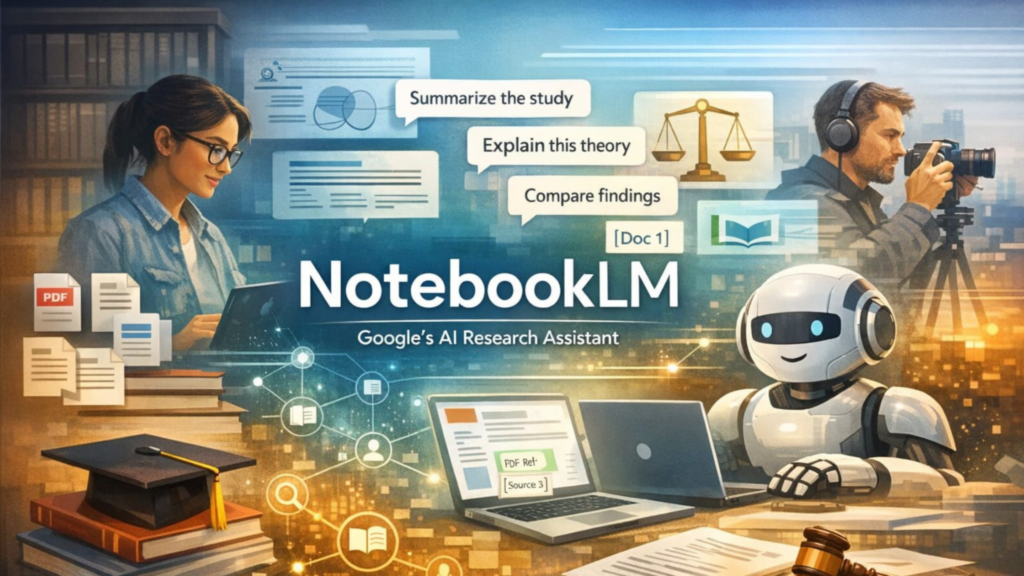
For years, AI tools have promised to help us “work smarter,” but most of them still operate at a distance from our actual knowledge. They generate content based on general training data, not on what we personally read, study, or trust. Google’s NotebookLM marks a meaningful shift away from that model.
Originally introduced as Project Tailwind and later rebranded as NotebookLM, this AI-powered research assistant is designed to work with your own sources, not instead of them. Rather than pulling answers from the open web, NotebookLM grounds its responses strictly in documents you upload research papers, PDFs, notes, reports, articles, or even entire books.
This seemingly simple distinction changes everything.
NotebookLM is not an AI article writer or a digital marketing tool in the traditional sense. It is a context-aware knowledge assistant, built for students, researchers, educators, journalists, policy analysts, and professionals who value accuracy, traceability, and deep understanding over generic text generation.
This article explores what NotebookLM is, how it works, why it matters, and where it fits in the rapidly evolving AI ecosystem.
What Is NotebookLM?
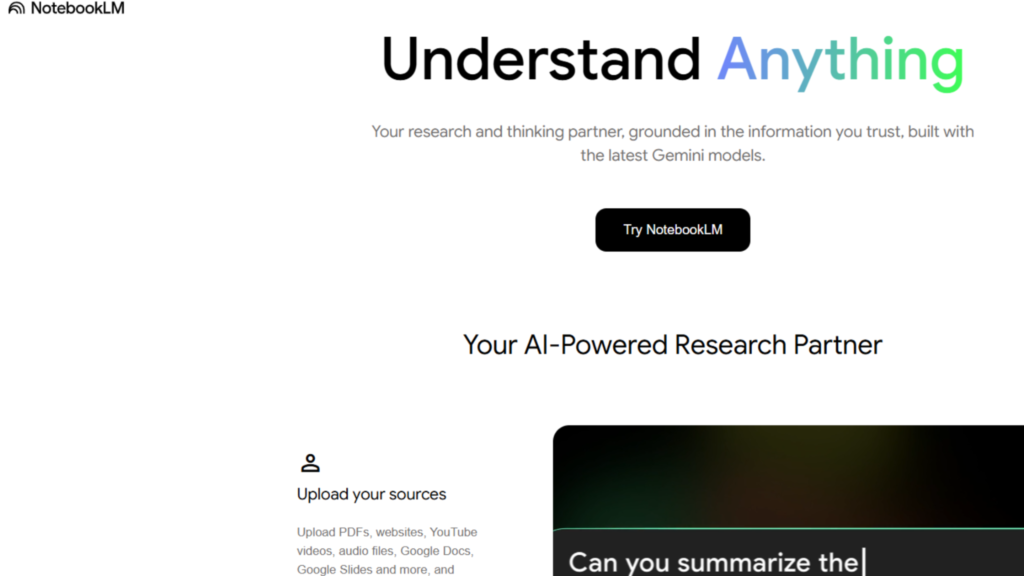
NotebookLM is an AI-powered research and note-taking assistant developed by Google, built on a large language model (LLM) from the Gemini family. Its core purpose is to help users understand, analyze, summarize, and connect information from their own uploaded materials.
Unlike conventional AI chatbots, NotebookLM does not rely on general internet knowledge when responding. Instead, it:
- Reads and indexes user-provided sources.
- Generates answers grounded only in those sources.
- Provides citations and references to the exact passages used.
In essence, NotebookLM functions like a highly intelligent research partner that has read everything you uploaded and can instantly explain it back to you in clear language.
How NotebookLM Works
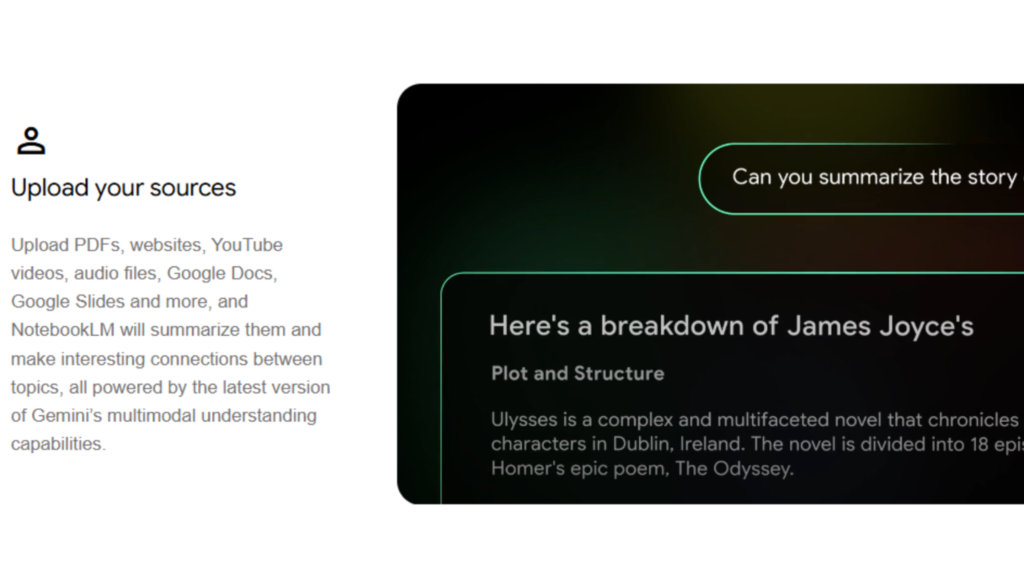
The workflow behind NotebookLM is deliberately simple but powerful. Users begin by creating a notebook and uploading source materials. These may include:
- Academic papers and PDFs
- Google Docs or text files
- Lecture notes and study material
- Policy briefs, reports, or legal documents
Once uploaded, NotebookLM processes the content and allows users to interact with it through natural language prompts.
You can ask questions such as:
- “Summarize the main argument of this paper”
- “Compare the perspectives in chapters 3 and 5”
- “Explain this concept in simple words”
- “What evidence supports this claim?”
Every response is explicitly tied to the source documents, often with inline citations. This source-grounded design significantly reduces hallucinations, a known problem in general-purpose AI systems.
Why NotebookLM Is Different From Other AI Tools
Most AI tools today prioritize content generation. NotebookLM prioritizes content understanding. This distinction places it in a different category altogether.
Traditional AI tools:
- Generate answers from broad training data
- May mix facts, assumptions, and guesses
- Often lack clear source attribution
NotebookLM:
- Uses only your uploaded sources
- Anchors responses in verifiable text
- Encourages critical thinking, not blind trust
Because of this, NotebookLM aligns strongly with academic integrity, professional research standards, and EEAT principles (Experience, Expertise, Authoritativeness, Trustworthiness).
Practical Use Cases of NotebookLM
NotebookLM is designed to support a wide range of users by turning complex documents into clear, actionable insights. From students to professionals, it helps save time while enhancing understanding and decision-making.
Academic Research and Study
Students and researchers can use NotebookLM to:
- Summarize lengthy papers
- Prepare literature reviews
- Clarify complex theories
- Compare multiple sources within one notebook
Instead of skimming hundreds of pages, users can interactively explore ideas while staying faithful to the original text.
Journalism and Policy Analysis
For journalists and analysts, NotebookLM helps:
- Extract key points from reports
- Identify contradictions or overlaps across documents
- Maintain factual accuracy through citations
This makes it especially useful in sensitive domains where misinformation has real consequences.
Education and Teaching
Educators can upload course materials and:
- Generate study guides
- Create discussion questions
- Explain difficult concepts at different levels
Students benefit from explanations that are directly tied to their curriculum, not generic internet summaries.
Knowledge Management for Professionals
Lawyers, consultants, researchers, and strategists can use NotebookLM to:
- Organize institutional knowledge
- Analyze internal documents
- Prepare briefings and summaries
In this context, NotebookLM becomes a private, secure knowledge assistant, not a public chatbot.
Is NotebookLM an AI Article Writer or Digital Marketing Tool?
Short answer: No.
NotebookLM is not designed to:
- Write SEO blogs from scratch
- Generate marketing copy
- Replace content creators
However, it can support these workflows indirectly by:
- Helping analyze research sources
- Summarizing background material
- Structuring insights based on uploaded documents
In other words, NotebookLM strengthens the thinking and research phase, not the promotional output stage.
Limitations and Considerations
Despite its strengths, NotebookLM is not without limitations.
- It depends entirely on the quality of uploaded sources.
- It does not browse the live web.
- It is not designed for creative storytelling or ad copy.
- Outputs are analytical, not persuasive by default.
These constraints are intentional. They reflect a design philosophy focused on accuracy over creativity.
The Bigger Picture: Why NotebookLM Important
NotebookLM represents a quiet but important evolution in AI. As AI tools become more powerful, the real challenge is no longer what they can generate, but what they can be trusted to explain.
By centering user-provided knowledge and transparent sourcing, NotebookLM moves AI closer to being a cognitive assistant, not just a text generator. For education, research, and professional work, this shift may prove more transformative than flashy content creation tools.
Final Takeaway
NotebookLM is not about replacing human expertise, it is about augmenting it responsibly. For anyone who works with complex information and values accuracy, transparency, and depth, NotebookLM stands out as one of the most thoughtful AI tools Google has released to date.
To enhance research accuracy and work more efficiently with trusted sources, explore more AI and productivity insights on our website Daily Digital Grind.
FAQs
Is NotebookLM free to use?
NotebookLM is currently available as an experimental Google product. Access and features may evolve over time as Google integrates it further into its AI ecosystem.
Does NotebookLM use internet data for answers?
No, NotebookLM generates responses strictly based on the documents you upload. It does not pull information from the open web.
Is NotebookLM suitable for SEO content creation?
NotebookLM is best suited for research, analysis, and understanding source material. While it can assist in preparing background knowledge, it is not designed as a dedicated SEO or marketing content generator.