
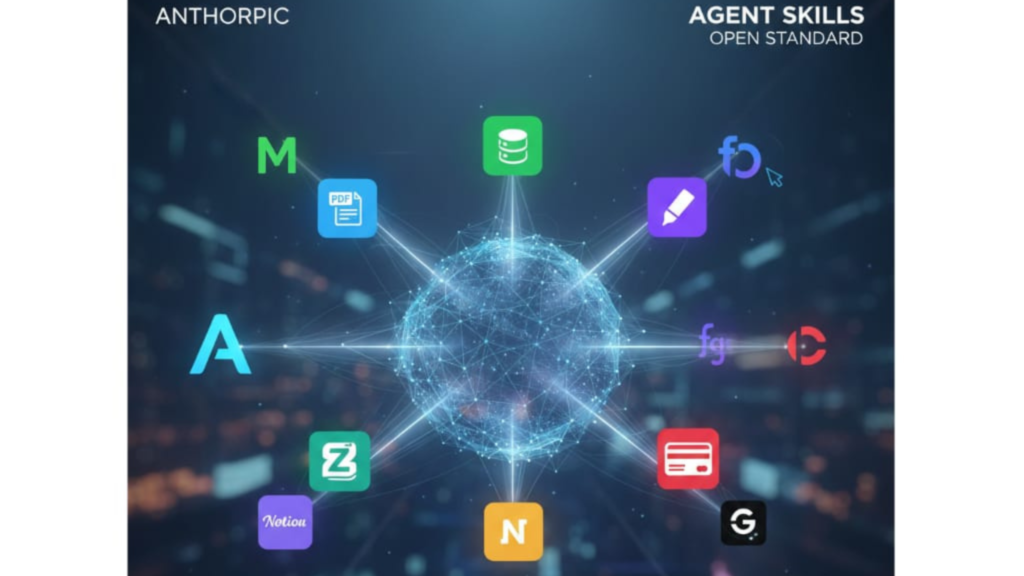
Anthropic has taken another major step toward shaping the backbone of the AI ecosystem with the release of Agent Skills as an open standard, continuing its strategic focus on building industry infrastructure rather than proprietary walled gardens. On December 18, the company published the full specification and SDK on agentskills.io, enabling any AI platform or developer to adopt the standard and build interoperable skills that work across systems.
This move echoes the trajectory of Anthropic’s earlier success with the Model Context Protocol (MCP), which became widely adopted as a universal way for AI agents to connect with external tools and was recently donated to the Linux Foundation. In both cases, Anthropic is leaning into solving core interoperability challenges that benefit the entire industry.
What Agent Skills Are
Agent Skills are modular capability packages that allow AI agents to dynamically load domain‑specific instructions, scripts, and resources. Each skill resides in a structured folder, anchored by a SKILL.md file that includes metadata describing its purpose. When an AI agent encounters a task relevant to a skill, it progressively loads only that information, a design Anthropic calls progressive disclosure an efficient way to enhance model performance without bloating context windows.
For example, a skill for handling PDF workflows might contain best‑practices, preferred libraries, and formatting preferences, while a skill for database interaction could embed safety checks and transactional logic. Rather than preloading all possible instructions into every interaction, agents fetch only what’s necessary, conserving resources and improving responsiveness.
Read Also: Accenture and Anthropic Partnership Boosts Enterprise AI
Following the MCP Playbook
Anthropic is deliberately repeating the playbook that helped MCP become a foundational industry standard:
- Identify real interoperability and tooling friction points.
- Develop a clear, lightweight specification.
- Release it openly to spur broad adoption.
- Let the community and partners create value around it.
Major players like Microsoft, OpenAI, Atlassian, Figma, Cursor, and GitHub have already adopted the standard. At launch, a growing directory of partner‑built skills is available including tools from Canva, Stripe, Notion, and Zapier giving developers ready‑to‑use building blocks for complex workflows.
The strategic logic is simple: if skills become the de facto way to codify agent‑focused expertise, Anthropic doesn’t need exclusive lock‑in; it just needs to be excellent at executing them. Whether a developer uses Claude, Codex, Cursor, or another agent that supports the spec, the same skill can run everywhere.
What This Means for the Industry
Interoperable skills could be a game changer for enterprise AI adoption and customization. One of the biggest challenges companies face today is vendor lock‑in custom workflows built for one platform often can’t be transferred to another. With Agent Skills, organizations can write a skill once and deploy it across multiple AI platforms that adopt the open spec.
Developers also gain a new distribution channel: a high‑quality skill can reach users across platforms without being siloed inside a single ecosystem. Enterprises can now build centralized skill governance tools, manage access and policy from an admin console, and monitor usage making Skills a part of IT‑ready infrastructure rather than ad‑hoc extensions.
By contrast, companies like OpenAI have focused on proprietary ecosystems (e.g., the GPT Store, platform SDKs). Anthropic’s open‑standards approach promotes cross‑ecosystem compatibility and shifts competition toward execution quality and developer experience rather than platform control.
Read Also: Who Really Owns Claude AI? Full Ownership Explained
Conclusion
With the Agent Skills standard now publicly available, Anthropic has anchored itself as a leading architect of AI infrastructure. Alongside MCP, Agent Skills represent foundational building blocks that empower diverse AI platforms to interoperate. Open standards like these help reduce fragmentation, enabling developers to build once and deploy everywhere a hallmark of mature, scalable tech ecosystems.
Anthropic is betting that a future built on shared standards will benefit the entire AI landscape and position Claude and its tools at the center of that world.
Stay with us for more AI news and tech updates! If you’re interested in contributing, submit your guest post and Write for Us.
FAQs
What exactly is the Agent Skills standard?
Agent Skills is a specification for modular capability packages directories with instructions and metadata that AI agents can dynamically load to perform specialized tasks. These skills are now an open standard, meaning any platform that adopts the spec can use them.
Why is making Agent Skills an open standard important?
Publishing Agent Skills openly promotes portability and interoperability. Skills written for one AI agent (like Claude) can work on other platforms (like Codex or VS Code) without rewriting. This helps reduce vendor lock‑in and simplifies enterprise AI customizations.
Who has already adopted the standard?
Early adopters include Microsoft, OpenAI, Atlassian, Figma, Cursor, and GitHub. A range of partner‑built skills from companies like Canva, Notion, Stripe, and Zapier are available at launch.